The Vibe Coding Revolution: AI Transforms Software Development
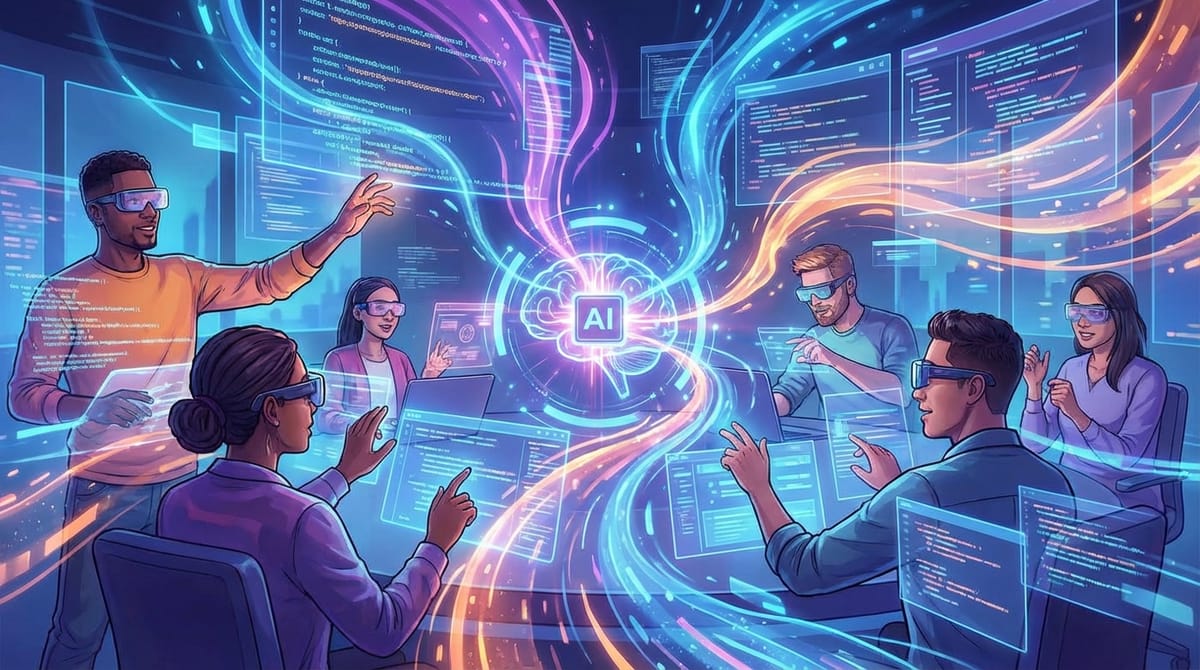
Software development has entered a radical transformation period where the traditional barriers to entry are crumbling. The emergence of what developers are calling "vibe coding" - a conversational, intuition-driven approach to building software through AI assistants - represents more than just a new tool in the programmer's toolkit. It signals a fundamental shift in who can participate in software creation and what it means to be a developer in 2026.
This revolution extends beyond simple code completion. We're witnessing the rise of autonomous AI agents that can execute entire development workflows, from interpreting user stories to deploying finished features. Combined with chat-oriented programming interfaces and multi-agent systems, these technologies are redefining the relationship between human creativity and machine execution. The implications ripple through every aspect of software development, from individual productivity to enterprise security, and from skill requirements to organizational structure.
Yet this transformation arrives with significant challenges. As AI-generated code now comprises 24% of global production code, security vulnerabilities are proliferating at an alarming rate. The technology promises democratized access to software creation while simultaneously demanding new forms of expertise, vigilance, and governance. Understanding this paradox is essential for anyone involved in building digital products.
From Code Writing to Code Curation
The traditional image of a software developer hunched over a keyboard, meticulously typing out lines of code, is becoming obsolete. Developers are transitioning from being primarily code writers to becoming curators, reviewers, and supervisors of AI-generated code. This shift fundamentally alters the daily workflow and cognitive demands of software development.
AI tools now automate tasks that once consumed the majority of a developer's time: writing boilerplate code, creating test suites, detecting anomalies, and even refactoring legacy systems. What remains - and what has become more critical - is the exercise of judgment. Developers must guide automation with domain knowledge, provide essential context that AI systems lack, and maintain accountability for the systems they oversee. The value proposition has migrated from typing speed and syntax memorization to critical thinking and architectural vision.
This evolution requires a new skill set. Modern developers need to excel at prompt engineering, understand the capabilities and limitations of various AI models, and develop an intuition for when AI assistance enhances productivity versus when it introduces risk. They must become expert validators, capable of quickly assessing whether AI-generated code meets security standards, follows best practices, and aligns with broader system architecture. The role has become more strategic and less tactical, demanding higher-level thinking about system design rather than granular implementation details.
The Vibe Coding Phenomenon
Vibe coding represents a paradigm shift in how humans interact with development tools. Rather than learning rigid programming syntax and memorizing API documentation, developers can now describe what they want to build in natural language, iterating through conversation until the desired functionality emerges. This chat-oriented programming style lowers the barrier to entry dramatically, enabling people with domain expertise but limited coding experience to participate in software creation.
The approach works through iterative dialogue. A developer might start with a high-level description: "I need a user authentication system with email verification and password reset functionality." The AI generates an initial implementation, which the developer reviews and refines through follow-up prompts: "Add rate limiting to prevent brute force attacks" or "Make the email templates customizable." This back-and-forth continues until the code meets requirements.
What makes vibe coding powerful is its accessibility. Product managers can prototype features to validate concepts before involving engineering teams. Business analysts can build internal tools without waiting for development resources. Domain experts can translate their knowledge directly into functioning applications. The cognitive load shifts from remembering syntax to clearly articulating requirements and evaluating results - skills that align more naturally with how humans think about problems.
However, this accessibility comes with caveats. The ease of generating code can create a false sense of competence, leading users to deploy systems they don't fully understand. The "vibe" must be backed by sufficient technical literacy to recognize when AI-generated solutions are flawed, insecure, or inefficient. The democratization of coding doesn't eliminate the need for expertise; it redistributes where that expertise matters most.
The Rise of Autonomous AI Agents
While AI coding assistants have dominated recent conversations, autonomous AI agents represent the next evolutionary leap. These systems move beyond responding to individual prompts, instead executing multi-step workflows with minimal human intervention. An agent might receive a user story, generate the necessary code across multiple files, write comprehensive tests, update documentation, and even handle deployment - all without continuous human prompting.
Gartner predicts that by 2028, 90% of engineers will be orchestrating AI-driven processes rather than writing code directly. This forecast reflects a fundamental change in how software gets built. The developer's role shifts toward architecture, governance, and orchestration of complex AI-driven systems. Instead of implementing features line by line, developers define requirements, establish guardrails, and verify outcomes.
Multi-agent systems add another dimension to this capability. Different specialized agents can handle distinct aspects of development: one focused on frontend implementation, another on backend logic, a third on database optimization, and a fourth on security review. These agents collaborate through dynamic prompt orchestration, passing context between themselves and building on each other's work. The Model Context Protocol (MCP) has emerged as a standard for enabling these inter-agent communications, allowing different AI systems to share information effectively.
The strategic implications are profound. The value of software development partners shifts from their ability to produce code to their capacity for architecting systems, establishing governance frameworks, and orchestrating AI agents effectively. Core human skills - critical thinking, system design, and business acumen - become the limiting factors in software development, regardless of how advanced the AI becomes. Organizations that recognize this shift early and invest in these capabilities will maintain competitive advantages as the technology matures.
Security Risks and the Illusion of Correctness
AI-generated code presents a deceptive challenge: it often looks correct while harboring serious vulnerabilities. This "illusion of correctness" has become one of the most significant security concerns in enterprise software development. Code produced by AI systems typically follows clean formatting conventions, uses appropriate variable names, and appears professionally written - yet may contain subtle flaws that compromise security.
The statistics are sobering. AI-generated code now accounts for one in five security breaches despite representing 24% of production code. This disproportionate risk stems from multiple factors: AI models trained on publicly available code may reproduce common vulnerabilities, lack awareness of organization-specific security requirements, and generate implementations that work functionally but fail under adversarial conditions.
Research reveals a troubling trend in developer behavior. Nearly half of developers do not thoroughly validate AI-generated code before integrating it into production systems. This overreliance on AI outputs creates systematic vulnerabilities as flawed code propagates through codebases. The polished appearance of AI-generated code encourages trust, while the speed at which it can be produced discourages careful review.
Organizations are responding with new security practices. A Black Duck survey found a 12% increase in teams conducting risk evaluations for where LLM-generated code can be used, along with a 10% rise in custom security rules targeting AI-specific vulnerabilities. Adoption of Software Bills of Materials (SBOMs) has surged nearly 30%, providing transparency into code origins whether written by humans, AI, or third parties. Automated infrastructure verification has increased over 50% as organizations seek technical controls to supplement human review.
Regulatory pressure accelerates these security investments. The EU Cyber Resilience Act and new U.S. requirements impose liability for software vulnerabilities, making AI-generated code a compliance concern in addition to a technical one. Organizations must establish clear governance frameworks defining when AI assistance is appropriate, what review processes apply, and who bears responsibility for AI-generated code in production systems.
Enterprise Adoption and Integration
Major technology companies are racing to embed AI capabilities throughout their development ecosystems. IBM's partnership with Anthropic to integrate Claude into IBM's AI-powered integrated development environment exemplifies this trend. Over 6,000 early adopters of IBM's IDE have reported productivity gains averaging 45%, demonstrating the substantial efficiency improvements possible when AI assistance is properly integrated into development workflows.
The IBM-Anthropic collaboration focuses on automating tasks throughout the entire software development lifecycle. This includes application modernization - updating legacy systems to modern architectures - code refactoring, and handling security and compliance requirements. The IDE incorporates enterprise-grade security features, including quantum-safe cryptographic migration, addressing the security concerns that make many organizations hesitant to adopt AI coding tools.
Charter Communications' partnership with AWS illustrates how AI development tools are expanding beyond pure software companies. Charter is integrating GitLab Duo with Amazon Q Developer to standardize software processes and accelerate feature rollout for Spectrum Internet, TV, and Mobile services. This collaboration extends to developing agentic AI solutions throughout Charter's operations, demonstrating how AI coding capabilities enable organizations to build custom automation for their specific business contexts.
These enterprise integrations reveal a pattern: successful AI adoption in software development requires more than access to capable models. Organizations need secure integration with existing development infrastructure, governance frameworks that define appropriate use cases, and training programs that help developers transition from traditional coding to AI orchestration. The companies seeing substantial productivity gains are those treating AI as a systemic change requiring organizational adaptation, not simply a new tool to bolt onto existing processes.
The Model Context Protocol and Standardization
As AI agents become more sophisticated and multi-agent systems more common, the need for standardized communication protocols has become critical. The Model Context Protocol (MCP) addresses this need by providing a framework for different AI systems to share information, context, and intermediate results effectively. This standardization enables the complex orchestrations that make autonomous development workflows possible.
Without common protocols, each AI agent operates in isolation, unable to build on the work of others or share relevant context. MCP creates a lingua franca for AI systems, allowing a frontend-focused agent to pass interface requirements to a backend agent, which can then communicate data structure needs to a database optimization agent. This orchestration mirrors how human development teams collaborate, but operates at machine speed.
IBM and Anthropic released a guide titled "Architecting Secure Enterprise AI Agents with MCP" to support organizations building secure, enterprise-grade AI agent systems. The focus on security within the protocol itself reflects growing recognition that AI agent systems must incorporate security considerations from the ground up, not as an afterthought. As these agents gain autonomy and execute increasingly complex workflows, the potential impact of compromised or misbehaving agents grows substantially.
The emergence of MCP and similar standards suggests the AI coding ecosystem is maturing beyond the experimental phase. Standardization enables interoperability, reduces vendor lock-in, and allows organizations to build complex systems from components provided by different vendors. This mirrors the evolution of earlier technology waves, where initial fragmentation eventually gives way to standardized protocols that enable the next phase of innovation.
Organizational Restructuring for the AI Era
Google's major reorganization merging Android and Chrome software divisions with Pixel and Fitbit hardware divisions illustrates how AI is reshaping corporate structure beyond just development practices. This integration aims to accelerate AI adoption across Google's consumer products by breaking down barriers between software and hardware teams. CEO Sundar Pichai emphasized the consolidation would "turbocharge" innovation in Android and Chrome while enhancing AI integration throughout the ecosystem.
The restructuring represents a strategic shift. Google historically maintained separation between software and hardware teams to remain neutral toward other Android manufacturers. The rise of AI capabilities has made this separation a competitive disadvantage, as tight integration between hardware and software enables more sophisticated AI features. The Pixel smartphone now serves as a showcase for Google's AI capabilities, with features like the AI-powered camera demonstrating what becomes possible when AI considerations drive unified product development.
This organizational evolution reflects a broader principle: maximizing AI's potential in software development requires rethinking team structures, reporting relationships, and decision-making processes. Companies organized around traditional functional silos struggle to implement the cross-functional orchestration that AI-driven development enables. Organizations are flattening hierarchies, creating cross-functional teams with shared AI literacy, and establishing new roles focused on AI governance and orchestration.
The changes extend to leadership skills. Technical leaders must now understand AI capabilities and limitations well enough to make architectural decisions that leverage AI effectively. Product leaders need sufficient technical literacy to distinguish between AI-appropriate and AI-inappropriate use cases. The most successful organizations are investing heavily in AI education across all levels, ensuring that strategic decisions about AI adoption are informed by realistic understanding of the technology's current state.
The Future of Software Development Skills
The skills required for software development success are shifting dramatically. Traditional programming proficiency remains valuable, but it's no longer sufficient. Developers must now excel at prompt engineering - crafting inputs that elicit desired outputs from AI systems. This requires understanding how language models interpret instructions, what context they need to generate appropriate code, and how to iteratively refine prompts to improve results.
Critical judgment becomes paramount. When AI can generate thousands of lines of code in seconds, the bottleneck shifts to evaluation. Can this code be trusted? Does it follow security best practices? Will it perform adequately at scale? Does it align with the broader system architecture? Answering these questions requires deep technical knowledge combined with experience-based intuition that AI systems don't possess.
Domain knowledge and business acumen increase in importance relative to pure coding ability. As AI handles more implementation details, the ability to translate business requirements into technical specifications becomes the critical skill. Developers who understand the business context, can identify edge cases, and anticipate user needs provide value that AI cannot replicate. The developer role is becoming more consultative, requiring communication skills and stakeholder management abilities that weren't historically emphasized in technical training.
System design and architecture skills become differentiators. While AI can implement individual features effectively, designing coherent systems that balance competing concerns - performance, security, maintainability, cost - remains fundamentally human work. Architects who can envision how components fit together, anticipate scaling challenges, and make principled tradeoffs will remain in high demand regardless of how sophisticated AI coding tools become.
Conclusion: Navigating the Transition
The vibe coding revolution represents a fundamental transformation in software development, not merely an incremental improvement in tooling. The barriers to entry are lowering, enabling broader participation in software creation while simultaneously demanding new forms of expertise from professional developers. AI agents are evolving from assistants that respond to prompts into autonomous systems that execute complex workflows, changing the nature of development work from implementation to orchestration.
This transition creates both opportunities and risks. Organizations can achieve substantial productivity gains - as demonstrated by the 45% improvements seen in early IBM IDE adopters - while simultaneously facing new security challenges as AI-generated code proliferates. The illusion of correctness that polished AI output creates requires heightened vigilance and new validation practices. Success requires treating AI adoption as a systemic organizational change, not just a technical upgrade.
The developers who thrive in this new environment will be those who embrace the shift from code writing to code curation, who develop strong critical judgment about AI outputs, and who build deep domain knowledge that complements AI capabilities. Organizations that succeed will establish clear governance frameworks, invest in AI literacy across all levels, and restructure teams to enable the cross-functional collaboration that AI-driven development demands.
The software development profession is not disappearing - it's evolving. The core human skills of critical thinking, system design, and business acumen remain essential. What's changing is how these skills get applied, with less time spent on mechanical implementation and more on strategic decision-making. For those willing to adapt, the vibe coding revolution opens possibilities for building software faster, more accessibly, and at greater scale than ever before. The challenge lies in harnessing these capabilities while maintaining the security, reliability, and quality that production systems require.
Sources
- Built In - How AI Transformed the Role of Software Developers
- arXiv - Generative AI and Software Design, Writing, and Maintenance
- ITPro - AI-Generated Code Security Risks
- Developers.dev - How AI is Changing Software Development
- AP News - Google Reorganization for AI Integration
- TechRadar - Anthropic and IBM Partnership
- TV Technology - Charter Communications AWS Partnership