Physical AI Closes the Brain-Body Gap Driving the Robotics Revolution
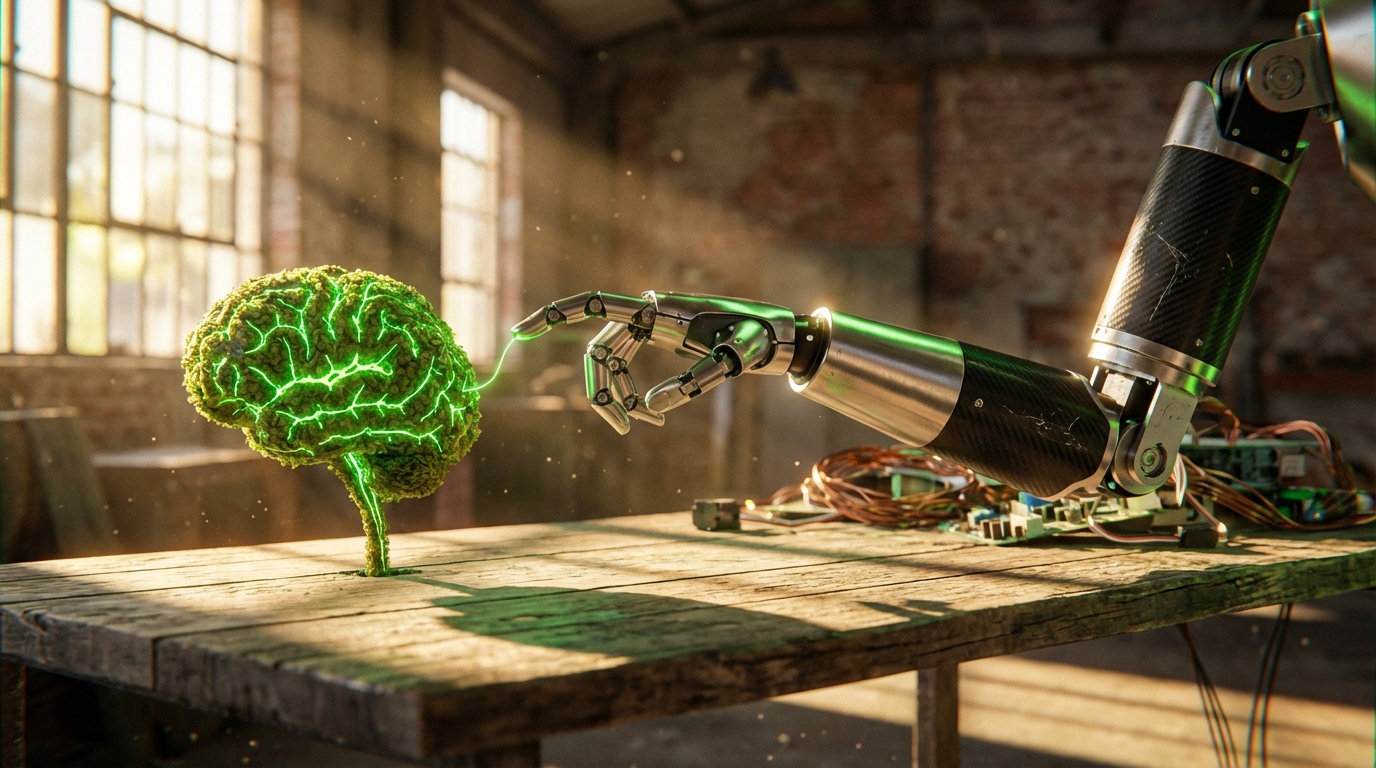
Robots have long been able to think or move – but rarely both at once with any real grace. A factory arm welds the same seam thousands of times without deviation, while a large language model writes poetry it will never physically touch. That disconnect between digital intelligence and physical capability is what researchers call the brain-body gap, and it has kept robotics stuck in controlled, repetitive environments for decades.
Physical AI changes the equation. By fusing perception, reasoning, and motor control into a single closed-loop system, Physical AI gives machines the ability to sense their surroundings, make contextual decisions, and act autonomously – all in real time. The body is no longer just a vessel for pre-written instructions; it becomes an active participant in intelligence itself. Sensor placement, joint configuration, material properties – these physical attributes directly shape how the system learns and adapts. The result is a new class of robot that doesn’t just execute. It understands.
With global robot density reaching 162 units per 10,000 employees in 2023 – double the figure from seven years earlier – the demand for smarter, more flexible automation has never been more urgent. Physical AI is answering that demand, and the implications stretch from warehouse floors to operating rooms.
What Physical AI Actually Means
Physical AI describes intelligence that perceives the physical world and directly controls real-world actions through machines, robots, and edge systems. Its defining characteristic is the closed loop: perceive the environment through sensors and cameras, decide based on context and goals, act by controlling physical processes, and govern operations with safety and compliance. The output is action in the physical world – not information for a human to interpret.
Researchers Miriyev and Kovac formalized the concept as the coordinated development of materials, sensing, actuation, and computation within a robot’s body. In their framework, intelligence depends on the relationship between physical structure and software rather than on code alone. A later study published in Frontiers of Information Technology and Electronic Engineering expanded this to describe Physical AI as a multidisciplinary integration of autonomous robots, materials, structures, and perception.
The distinction matters commercially. Vision AI outputs information – alerts, classifications, insights – for humans to act on. Robotics provides the mechanical body. Physical AI unifies both into autonomous operations where the system completes the entire workflow without human intervention.
| Aspect | Vision AI | Physical AI | Traditional Robotics |
|---|---|---|---|
| Output | Information (alerts, classifications) | Autonomous actions (movements, control signals) | Physical capability (movement) |
| Loop Type | Open-loop (human acts on info) | Closed-loop (self-executes) | Pre-programmed sequences |
| Scope | Perception only | Perception + decision + action + governance | Hardware and mechanics |
| Intelligence | Analysis-focused | Adaptive, learning, coordinating | Limited or programmed |
Why the Brain-Body Gap Persisted So Long
Early robotic systems treated intelligence as something that lived far from the machine. Software analyzed data remotely while rigid hardware executed fixed commands. This separation worked in controlled settings – automotive welding lines, semiconductor fabs – but collapsed the moment conditions became unpredictable. Dust on a sensor, a shifted pallet, a human walking through the workspace – any deviation could halt production.
The problem ran deeper than software limitations. Traditional robots relied on proprietary programming languages tailored to each manufacturer, lacked standardized interfaces for data access, and had no integration with modern AI development frameworks. Reprogramming a robot for a new task required specialized engineers, significant financial investment, and costly downtime. For small and medium-sized manufacturers, this made advanced automation practically inaccessible.
Meanwhile, digital AI raced ahead. Large language models mastered human language, diffusion models generated photorealistic images, and reasoning systems solved complex mathematics. But all of it stayed trapped behind screens. As one robotics researcher put it, AI could write a sonnet about picking up an apple but couldn’t actually pick one up. Physical AI emerged precisely to resolve this paradox.
The Technology Stack Making It Possible
Several converging breakthroughs have moved Physical AI from laboratory concept to deployable technology between 2025 and 2026.
Vision-Language-Action Models
VLA models represent the architectural leap that gives robots a unified brain. Rather than treating vision, language understanding, and motor control as separate modules, VLAs weave text tokens, image tokens, and motor tokens into a single sequence. Give the system a natural language instruction like “place the red box on the third shelf,” and it can identify the object, understand the spatial relationship, and plan the physical motion. Google DeepMind’s RT-2 demonstrated this by enabling robots to complete previously unseen tasks through natural language commands alone.
GPU-Accelerated Simulation
NVIDIA’s Isaac platform combines GPU-accelerated simulation with robot foundation models, enabling developers to train robot policies at 1,000 times real-world speed inside digital twin environments. This dramatically compresses the cycle from concept to deployment. Reinforcement learning in simulation lets robots develop sophisticated behaviors through millions of trial-and-error iterations before ever touching physical hardware. Platforms like Isaac Sim offer physics accuracy sufficient to generate synthetic training data that transfers meaningfully to real robots.
Onboard Computing
Neural processing units optimized for edge computing now enable low-latency, energy-efficient AI processing directly on the robot. The NVIDIA Jetson platform, for example, delivers up to 40 TOPS of AI compute in a form factor small enough to mount on a collaborative robot arm. This onboard capability allows Physical AI systems to run VLA models, process high-speed sensor data, and make safety-critical decisions without cloud dependency – essential for autonomous vehicles, industrial robotics, and remote surgery.
Universal Manipulation Interface
UMI captures rich, first-person visual and motion data directly from human demonstrations without requiring a robot in the loop. Because it represents actions in relative, hardware-agnostic ways, demonstrations transfer across different robot arms, grippers, and platforms with minimal retraining. This decouples data collection from specific hardware, turning natural human interaction into universally applicable training data.
Physical AI in the Real World
The technology is already delivering measurable results across industries. In healthcare, Diligent Robotics deploys Moxi, a mobile manipulation robot that handles routine hospital logistics – delivering medications, transporting lab samples, fetching supplies – returning valuable time to nurses. Moxi’s intelligence grows through continuous learning from hospital environments, with operational data feeding back into its models for iterative improvement.
In manufacturing, Universal Robots has partnered with NVIDIA, Google DeepMind, Microsoft, and Siemens to build a Physical AI ecosystem around its collaborative robot platform. Their AI Accelerator, powered by NVIDIA Jetson and the PolyScope X control platform, enables rapid development of vision, perception, and motion planning applications. A recent industry survey found that 69% of companies already automating believe AI-driven robotics will be highly beneficial for their business.
Warehouse automation illustrates the distinction between robotics and Physical AI most clearly. Traditional robotics handles individual picking tasks according to programming. Physical AI orchestrates entire fleets of robots as a unified system – coordinating tasks dynamically, adapting to changing inventory conditions, and learning from outcomes to improve performance over time.
McKinsey estimates that deploying Physical AI in manufacturing scenarios can improve overall production line efficiency by 20-30% and reduce labor costs by 40-60%.
Training Approaches: Two Competing Philosophies
The industry has split into two camps on how best to train Physical AI systems, and the debate has real consequences for deployment speed and reliability.
The simulation-heavy approach, favored by Google DeepMind, Toyota Research Institute, and NVIDIA, starts with pre-trained VLA foundation models. Developers add small numbers of human demonstrations to create safe behavioral priors, then deploy reinforcement learning to discover new skills. Real-to-sim-to-real loops capture failure logs from deployed robots and feed them back into simulators, auto-tuning physics parameters until simulation matches reality.
The real-world imitation approach, championed by companies like Physical Intelligence and Covariant, relies on massive supervised learning at scale. Physical Intelligence uses approximately 50,000 teleoperation demonstrations, while Covariant leverages millions of manipulation attempts. These teams then accelerate learning through self-supervised techniques, mining every frame of robot data – including failed grasps and passive background motion – as implicit training material for physics understanding.
A critical milestone bridging both approaches is the Open X-Embodiment collaboration. Led by Google DeepMind with over 20 institutions, this project pooled data from 22 different robot types into a standardized dataset – what researchers have called the “ImageNet moment” for robotics. The key insight: a robot arm in one lab could improve its grip strategies by learning from completely different hardware elsewhere, demonstrating positive transfer across diverse embodiments.
Core Challenges That Remain
Physical AI’s promise is enormous, but significant hurdles stand between current capabilities and mainstream deployment.
- The sim-to-real gap: Simulated environments, no matter how sophisticated, cannot perfectly replicate real-world variability. Slippery surfaces, unexpected lighting changes, and novel object geometries still cause failures that simulation didn’t predict. Physical validation remains essential.
- Reliability at scale: A 99% accurate model looks impressive in a demo, but a single failure in perception or control can halt production or cause physical damage. The physical world punishes errors in ways that digital environments do not.
- Data efficiency: Robots cannot depend on endless field trials or billion-dollar data pipelines. Every real-world training example carries cost, time, and risk. The field needs systems that learn efficiently from limited experience rather than brute-force scale.
- Multi-agent coordination: Scaling from a single capable robot to coordinated fleets operating in shared, dynamic environments introduces exponential complexity in communication, planning, and safety.
- Hardware limitations: Battery life, actuator precision, and sensor reliability all constrain what Physical AI can accomplish regardless of software sophistication.
Physics-informed learning – embedding principles like gravity, friction, and contact dynamics directly into model architectures – offers the most promising path through several of these challenges simultaneously. When robots understand physical causality rather than merely memorizing patterns, they generalize better, fail less catastrophically, and require far less training data.
The Road Ahead: From Hype to Deployment
The humanoid robot market is projected to reach $38 billion by 2035, and 2025-2026 represents the critical transition from prototype validation to commercial piloting. Figure 02, Tesla Optimus Gen 2, and Boston Dynamics’ Electric Atlas are already conducting trials in logistics and manufacturing environments. Tesla has deployed dozens of Optimus prototypes in its own factories, leveraging its autonomous driving visual AI capabilities for environmental perception.
But the revolution extends well beyond humanoids. Physical AI encompasses smart spaces using fixed cameras and computer vision to optimize factory operations, digital twin simulations for virtual testing, sensor-based AI systems that help human teams manage complex environments, and autonomous vehicles that have already completed over 10 million paid rides in the case of Waymo’s robotaxi service.
The most compelling near-term opportunity may be augmented reality integration – keeping humans in the loop where both people and machines perceive the same environment and coordinate seamlessly. AR glasses gathering front-line data while robots execute physical tasks could represent the practical middle ground between full autonomy and human oversight.
Key Takeaways
Physical AI represents a fundamental shift from asking “can we automate this specific task?” to “can we build systems that learn like humans do?” By treating intelligence as something that emerges from the interplay of physical design and computational capability – not from code alone – Physical AI is closing the brain-body gap that limited robotics for decades. The closed-loop architecture of perceive, decide, act, and govern enables machines to operate in unstructured, dynamic environments where traditional automation fails. With foundation models maturing, simulation tools accelerating, and hardware costs declining, the transition from laboratory demonstrations to production-scale deployment is underway. Organizations evaluating automation strategies should recognize that Physical AI is not an incremental improvement to existing robotics – it is a new category of capability that demands coordinated investment in hardware, software, data infrastructure, and workforce development.
Sources
- How To Build Physical AI – Torque AGI
- Physical AI vs Vision AI vs Robotics Differences
- AI Goes Physical: Convergence of AI and Robotics
- Physical AI for Industrial Automation
- What is Physical AI? – AZoRobotics
- Complete Guide to Physical AI 2026
- Physical AI in Practice – AWS Machine Learning
- Embodied AI: Bridging the Gap to Cognition
- The Physical AI Revolution in Robotics
- Physical AI Deep Dive: Market Timing