NVIDIA's Physical AI Revolution: GR00T Robots and Alpamayo
NVIDIA has fundamentally shifted its AI strategy from digital intelligence to physical systems that interact with the real world. At CES 2026 in Las Vegas, CEO Jensen Huang declared the arrival of the "ChatGPT moment for physical AI" - a pivotal shift where machines don't just process information but understand, reason about, and act within physical environments. This transition represents years of development in robotics, autonomous driving, and simulation technologies converging into commercially viable products.
The announcements centered on two major platforms: Alpamayo, an open-source AI suite designed to bring human-like reasoning to autonomous vehicles, and expanded capabilities for the GR00T humanoid robot framework. These technologies showcase NVIDIA's comprehensive approach to physical AI, combining advanced neural networks with sophisticated simulation environments and real-world training data. The company demonstrated live autonomous driving in a Mercedes-Benz CLA and brought humanoid robots onto the stage, signaling that these technologies have moved beyond research labs into production-ready systems.
What distinguishes this push from previous autonomous systems is the emphasis on reasoning rather than mere pattern recognition. Traditional self-driving cars rely heavily on object detection and predefined rules. NVIDIA's new approach enables vehicles and robots to think through unprecedented scenarios, explain their decisions, and adapt to complex situations they've never encountered before.
Alpamayo: Reasoning-Based Autonomous Driving
Alpamayo represents NVIDIA's most ambitious autonomous driving initiative to date. Unlike conventional self-driving systems that focus primarily on sensor fusion and object detection, Alpamayo introduces chain-of-thought reasoning into the decision-making process. The flagship model, Alpamayo 1, is a 10-billion-parameter Vision-Language-Action (VLA) model that processes video inputs and generates driving paths while simultaneously articulating the reasoning behind each decision.
The system's architecture allows it to handle edge cases that have plagued autonomous driving development for years. When encountering a traffic light outage at a busy intersection, for example, Alpamayo doesn't simply stop or proceed based on predetermined rules. Instead, it evaluates the situation, considers traffic patterns, recognizes the malfunction, and determines the safest course of action - much like a human driver would assess an unfamiliar scenario. This reasoning capability extends to predicting potential hazards, anticipating the behavior of other road users, and navigating complex urban environments where unexpected situations are the norm rather than the exception.
NVIDIA has made Alpamayo 1 fully open-source, with weights and scripts available on Hugging Face. This openness allows developers to scale the model down for real-world vehicle deployment or build additional tools on top of the foundation, including evaluation systems and auto-labeling capabilities. The company envisions Alpamayo serving as a large-scale teacher model that developers can fine-tune and distill into the backbones of their complete autonomous driving stacks.
Supporting the model release, NVIDIA has published an extensive open dataset containing over 1,700 hours of driving footage captured across different geographic regions and weather conditions. Critically, this dataset includes rare scenarios that are difficult to capture through normal driving operations - the very situations where autonomous systems have historically struggled. Developers can use this data to train and validate their systems against the full spectrum of driving challenges.
AlpaSim: Virtual Testing at Scale
Complementing the Alpamayo model is AlpaSim, an open-source simulation tool that recreates real-world driving environments with high fidelity. Available on GitHub, AlpaSim allows developers to test autonomous systems at scale without putting vehicles on public roads. The simulator models everything from sensor characteristics and weather conditions to traffic patterns and pedestrian behavior, creating a safe sandbox for developing and validating autonomous driving algorithms.
The virtual training approach addresses one of the autonomous vehicle industry's most persistent challenges: accumulating sufficient real-world miles to validate safety. Physical testing is expensive, time-consuming, and inherently limited in the range of scenarios that can be safely encountered. Simulation enables developers to expose their systems to thousands of edge cases, dangerous situations, and rare events that might take years to encounter naturally. This accelerates development cycles and allows for more thorough safety validation before systems ever reach public roads.
Commercial Deployment and Industry Partnerships
Mercedes-Benz will be the first automaker to deploy Alpamayo-powered autonomous and driver-assistance features in production vehicles. The rollout begins in the United States during the first quarter of 2026, followed by Europe in the second quarter and Asia later in the year. The 2025 Mercedes-Benz CLA served as the demonstration vehicle at CES 2026, where it successfully navigated complex driving scenarios including intersection management and hazard anticipation without driver intervention.
Beyond Mercedes-Benz, several other companies have expressed interest in the platform. Lucid Motors, Uber, and Berkeley DeepDrive are among the organizations exploring Alpamayo integration. The open-source nature of the platform lowers barriers to entry for automotive manufacturers and technology companies looking to develop or enhance their autonomous capabilities without building foundational models from scratch.
Huang emphasized that NVIDIA began working on self-driving cars eight years ago with the understanding that they needed to build the entire stack - from chips and computing platforms to simulation environments and AI models. This vertical integration now allows the company to offer a comprehensive solution that addresses every layer of the autonomous driving challenge.
GR00T and the Humanoid Robot Ecosystem
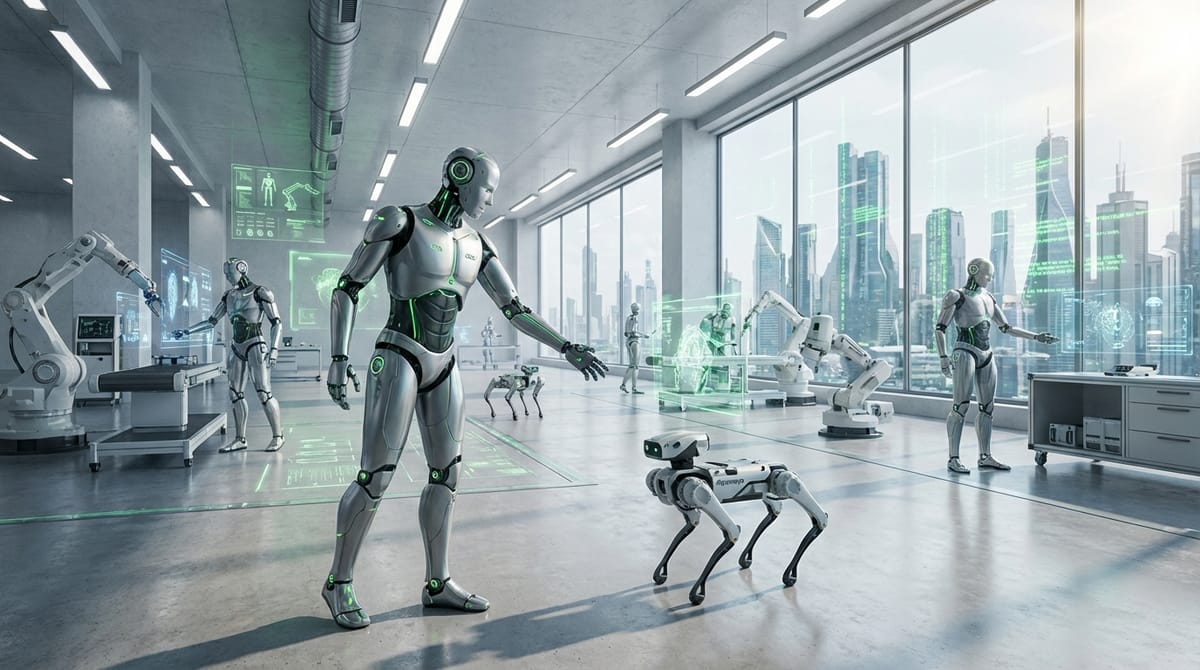
While Alpamayo focuses on autonomous vehicles, NVIDIA's GR00T platform targets humanoid robots and embodied AI systems. At the company's GTC 2025 conference earlier in the year, Huang unveiled Isaac GR00T N1, an open-source foundation model for humanoid robot development. This framework provides the core intelligence that allows robots to understand their physical environment, plan actions, and execute tasks in the real world.
The system leverages synthetic data generation and reinforcement learning to teach AI systems complex physical concepts like friction, momentum, and object permanence - fundamental physics that humans intuitively understand but that robots must explicitly learn. By training in simulated environments powered by NVIDIA's Cosmos model, robots can acquire skills and knowledge without the time and expense of purely physical training.
At CES 2026, Huang brought robots onto the stage to demonstrate the current state of the technology. Small droids reminiscent of Star Wars characters performed live demonstrations, showcasing the practical application of GR00T-powered systems. While these demonstrations featured smaller robots, the technology scales to full humanoid platforms capable of performing complex manipulation tasks.
Strategic Partnerships in Robotics
NVIDIA announced a strategic AI partnership with Boston Dynamics and Google DeepMind, bringing together three powerhouses in robotics and artificial intelligence. Boston Dynamics, now owned by Hyundai, publicly demonstrated its humanoid robot Atlas for the first time as a non-prototype system. The robot walked around the stage and waved to the crowd, marking its transition from research project to commercial product.
Hyundai stated that Atlas is designed to reduce repetitive human physical tasks and perform higher-risk activities, laying the groundwork for robot commercialization and collaborative human-robot environments. A production version of Atlas specifically designed to help assemble cars is already in manufacturing and will be deployed at Hyundai's electric vehicle facility near Georgia by 2028. This represents one of the first confirmed large-scale deployments of humanoid robots in automotive manufacturing.
The partnership extends beyond Atlas. Hyundai revealed its broader robot strategy, including the MobED Droid, a wheeled robot capable of traversing various terrain types. The MobED Droid received a CES 2026 Innovation Award, recognizing its potential applications in logistics, delivery, and mobile assistance. Companies including Uber Eats, LG, and Boston Dynamics are exploring applications for NVIDIA's robotic technologies, suggesting a diverse ecosystem of physical AI applications emerging across industries.
NVIDIA's Organized AI Model Portfolio
NVIDIA has structured its AI offerings into six domain-specific portfolios, each addressing different industry needs with pre-trained models that developers can customize and deploy. This organizational strategy allows companies to build AI applications without starting from scratch, dramatically reducing development time and costs.
The six domains are:
- Clara: Healthcare applications including medical imaging, drug discovery, and genomics analysis
- Earth-2: Climate science and weather prediction models for environmental research
- Nemotron: Reasoning and multimodal AI capabilities for general-purpose applications
- Cosmos: Robotics simulation and training data generation
- GR00T: Embodied intelligence for humanoid robots and physical AI systems
- Alpamayo: Autonomous driving with reasoning capabilities
These models are trained on NVIDIA's own supercomputers and made available for developers and organizations to build upon. The approach reflects a shift in AI development philosophy - rather than every company building foundational models independently, NVIDIA provides robust starting points that can be fine-tuned for specific applications. This democratizes access to advanced AI capabilities and accelerates the deployment of AI features in consumer applications, vehicles, and devices.
Hardware and Infrastructure Evolution
Supporting these software advances, NVIDIA continues to evolve its hardware architecture. At GTC 2025, Huang unveiled the Rubin AI chip architecture, declaring AI at an "inflection point." The company detailed a roadmap that includes Blackwell Ultra chips launching in late 2025, Rubin AI chips in 2026, and Rubin Ultra in 2027. This aggressive release schedule ensures that the computational power required for increasingly sophisticated AI models continues to scale.
Huang forecasted that data center infrastructure revenue will reach $1 trillion by 2028, driven by the computational demands of agentic AI, physical AI, and large-scale model training. This infrastructure buildout is essential for supporting the simulation environments, training pipelines, and inference systems that power autonomous vehicles and robots.
NVIDIA also introduced Newton, an open-source physics engine for robotic simulations, developed in collaboration with Google DeepMind and Disney Research. Newton provides highly accurate physics modeling that allows robots to train in virtual environments that closely mirror real-world physical properties. This collaboration brings together expertise in AI, animation physics, and robotics to create more effective training environments.
For autonomous driving specifically, NVIDIA revealed its Halos safety system, designed to provide additional layers of verification and fail-safe mechanisms for self-driving vehicles. The company also highlighted its partnership with General Motors for AI-integrated self-driving cars, utilizing Omniverse and Cosmos platforms for development and testing.
The Physical AI Paradigm Shift
NVIDIA's emphasis on "physical AI" represents a fundamental expansion of artificial intelligence beyond digital domains. While previous AI breakthroughs focused on language, image generation, and data analysis, physical AI must contend with the complexities of the real world - unpredictable environments, physical constraints, safety requirements, and real-time decision-making with tangible consequences.
Huang's comparison to the "ChatGPT moment" is deliberate. ChatGPT demonstrated that large language models could achieve broad utility and mainstream adoption when they crossed certain capability thresholds. NVIDIA argues that physical AI has now reached similar inflection points - the models are sophisticated enough, the hardware is powerful enough, and the simulation tools are realistic enough to deploy these systems in real-world applications.
The breakthroughs enabling this shift include advances in vision-language-action models that can process multimodal inputs and generate physical actions, reinforcement learning techniques that allow systems to learn from simulation and transfer that knowledge to reality, and synthetic data generation that can create training scenarios impossible or impractical to capture naturally.
Despite the optimism, challenges remain. Self-driving vehicles are operating in various cities worldwide, with Waymo leading commercial deployments, but they're not yet perfect. Some autonomous vehicles have caused traffic jams, gotten confused in certain situations, or required human intervention. The reasoning capabilities that Alpamayo introduces should help address these edge cases, but extensive real-world validation is still required.
Looking Forward: The Road to Ubiquitous Physical AI
The technologies unveiled at CES 2026 and throughout early 2026 set the stage for a significant expansion of AI into physical domains over the coming years. Mercedes-Benz's deployment of Alpamayo-powered features will provide crucial real-world data on how reasoning-based autonomous systems perform across diverse driving conditions and geographies. Success could accelerate adoption among other automakers and mobility companies.
In robotics, Hyundai's 2028 deployment of Atlas robots in automotive manufacturing will serve as a high-profile test case for humanoid robots in industrial settings. If these robots successfully perform assembly tasks alongside human workers, it could validate the business case for humanoid robots and spur broader industrial adoption. The diversity of companies exploring NVIDIA's robotic platforms - from delivery services to consumer electronics manufacturers - suggests applications will emerge across multiple sectors simultaneously.
The open-source nature of both Alpamayo and GR00T lowers barriers to innovation and allows a broader developer community to contribute to advancing these technologies. This openness could accelerate development cycles and lead to applications NVIDIA hasn't anticipated. However, it also raises questions about safety validation, liability, and ensuring that derivative systems maintain appropriate safety standards.
NVIDIA's organized portfolio approach - providing domain-specific foundation models across healthcare, climate, robotics, and other fields - positions the company as infrastructure provider for the AI economy. Rather than building end-user applications directly, NVIDIA enables other companies to develop AI-powered products and services. This strategy could prove highly lucrative as AI deployment expands across industries, though it also means NVIDIA's success depends on its partners successfully commercializing these technologies.
The company's aggressive hardware roadmap ensures that computational capabilities will continue scaling to meet the demands of increasingly sophisticated AI models. As models grow larger and more capable, the infrastructure to train and deploy them becomes more critical. NVIDIA's position spanning both hardware and software gives it unique advantages in this evolving landscape.
Conclusion
NVIDIA's CES 2026 announcements mark a decisive move from digital AI to physical AI systems that interact with and navigate the real world. Alpamayo brings reasoning capabilities to autonomous vehicles, allowing them to handle complex scenarios and explain their decisions in ways that traditional self-driving systems cannot. The GR00T platform and partnerships with robotics leaders like Boston Dynamics position NVIDIA as a central enabler of the humanoid robot ecosystem.
The "ChatGPT moment for physical AI" that Huang proclaimed may indeed be arriving. The convergence of advanced neural architectures, sophisticated simulation environments, open-source development approaches, and powerful hardware creates conditions for rapid advancement. Mercedes-Benz vehicles with Alpamayo technology will begin reaching customers within weeks, and humanoid robots are moving from research demonstrations to production deployments.
Challenges remain in safety validation, regulatory approval, and achieving the reliability required for widespread adoption. But the trajectory is clear - AI is expanding beyond screens and speakers into vehicles, robots, and physical systems that will increasingly share our roads, workplaces, and daily environments. NVIDIA has positioned itself at the center of this transformation, providing the models, tools, and computational infrastructure that will power the next generation of intelligent machines.
Sources
- TechCrunch - NVIDIA Launches Alpamayo Open AI Models
- Business Standard - NVIDIA at CES 2026
- Economic Times - CES 2026 NVIDIA Major Announcements
- TechRadar - NVIDIA CES 2026 Live Coverage
- Euronews - Future of Autonomous Driving and Robots at CES
- AP News - NVIDIA GTC 2025 Conference Coverage
- NDTV - NVIDIA Alpamayo Open Source AI Suite
- Yahoo Finance - NVIDIA Announces Humanoid Robot Plans