Meta’s Four New MTIA Chips Signal a Bold Shift Away From Nvidia
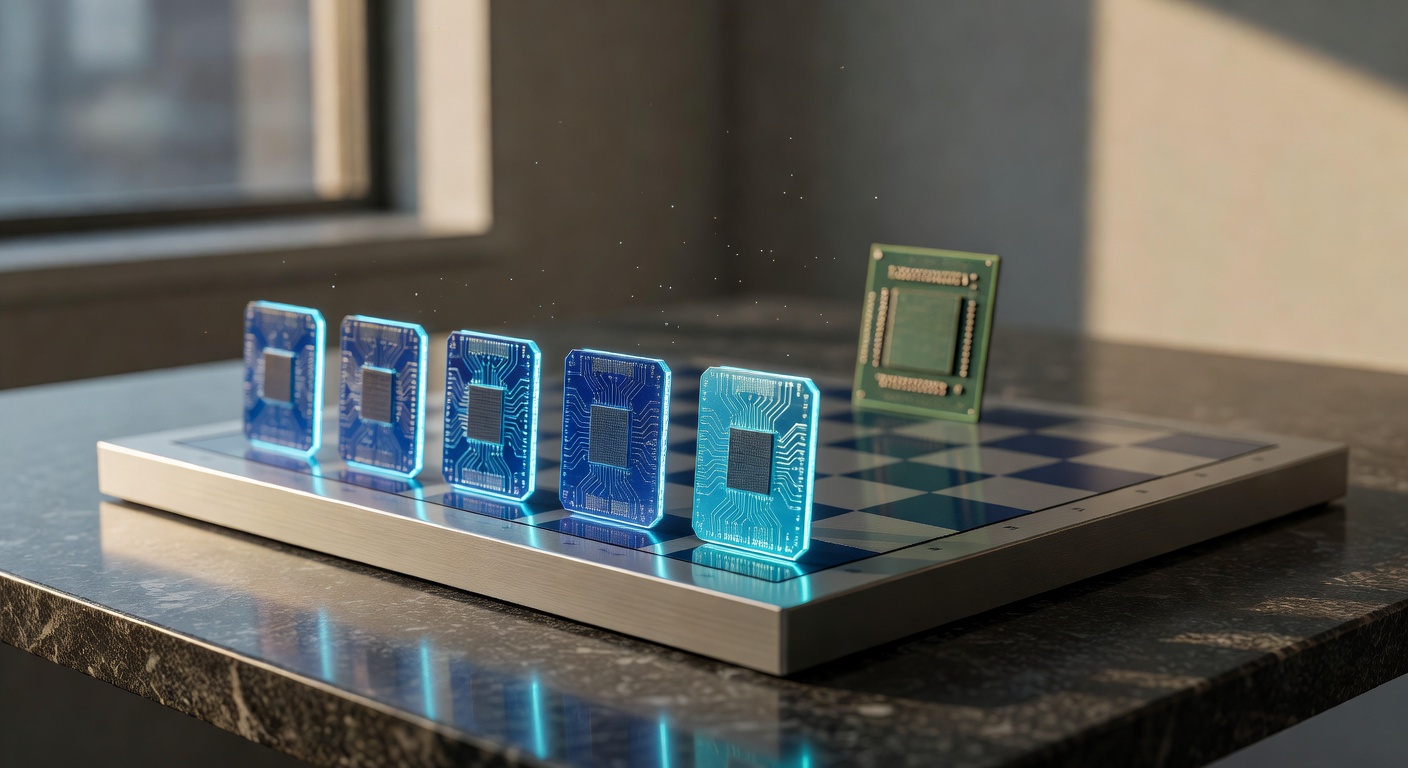
Meta is building its own path in the AI chip race – and it is moving fast. On March 11, 2026, the company announced a roadmap for four new generations of its Meta Training and Inference Accelerator (MTIA) chips: the MTIA 300, 400, 450, and 500. All four are scheduled for deployment by the end of 2027, with the MTIA 300 already running in production across Meta’s apps. The pace is staggering – roughly one new chip generation every six months, a cadence that doubles or quadruples the semiconductor industry norm.
The strategic goal is clear: reduce Meta’s dependence on Nvidia’s expensive GPUs for the inference workloads that power recommendations, ranking, and generative AI features for 3.58 billion daily active users. But this is not a clean break. Meta continues to invest billions in Nvidia and AMD hardware for training and peak-load tasks. What is emerging instead is a hybrid infrastructure strategy where custom silicon handles the bulk of inference, and merchant GPUs tackle the heaviest training jobs.
The announcement lands in a landscape where every major hyperscaler – Google with TPUs, Amazon with Trainium and Inferentia, Microsoft with Maia – is chasing the same objective: control costs, secure supply chains, and optimize for workloads that off-the-shelf GPUs were never specifically designed to handle.
The Four-Chip Roadmap at a Glance
Meta’s MTIA roadmap compresses what most chip companies accomplish in four to eight years into just 24 months. Here is how the four generations break down:
| Chip | Primary Focus | Status | Deployment Timeline |
|---|---|---|---|
| MTIA 300 | Ranking and recommendation training | In production | Deployed weeks before March 11, 2026 |
| MTIA 400 | R&R plus general GenAI workloads | Tested in labs | Moving to deployment mid-2026 |
| MTIA 450 | Optimized for GenAI inference | Planned | Mass deployment early 2027 |
| MTIA 500 | Advanced GenAI inference | Planned | Mass deployment 2027 |
Hundreds of thousands of MTIA chips already run inference daily across Facebook and Instagram, handling organic content and ads workloads. The MTIA 400 features a 72-accelerator scale-up domain designed to deliver performance competitive with leading commercial products. MTIA 450 doubles high-bandwidth memory bandwidth compared with MTIA 400 and adds inference-specific optimizations including low-precision data types and hardware acceleration for attention and feed-forward network performance. MTIA 500 pushes further still, with a 50% increase in HBM bandwidth, up to 80% more HBM capacity, and a 43% increase in MX4 FLOPS over the 450.
Across the full roadmap, HBM bandwidth rises by 4.5x from MTIA 300 to MTIA 500, while compute FLOPS increase by 25x – all in less than two years.
Why Inference, Not Training, Is the Target
This is where Meta’s strategy diverges most sharply from the conventional playbook. Mainstream GPUs from Nvidia and AMD are typically optimized first for the compute-hungry work of training massive AI models, then repurposed for inference. Meta is flipping that approach entirely. MTIA 450 and 500 are designed inference-first, then adapted backward for training workloads.
The reasoning is economic. Training a large language model is an enormous but finite task. Inference – generating responses, ranking content, serving recommendations – is a recurring cost that scales with every user interaction. Meta runs trillions of inferences daily across its family of apps. When you are serving 3.58 billion daily active users, even marginal per-inference cost savings compound into billions of dollars. Custom chips optimized specifically for these lighter but high-volume workloads can deliver two to three times better cost efficiency than repurposed training GPUs, according to industry estimates of ASIC advantages in optimized inference scenarios.
The Modular Architecture Enabling Six-Month Cycles
A six-month chip development cadence sounds almost reckless by semiconductor standards. Meta VP of Engineering Yee Jiun Song acknowledged the timeline is “unusual for any silicon company.” The secret is modular design.
Rather than building monolithic chips from scratch each generation, Meta constructed MTIA around reusable chiplets for compute, I/O, and networking. This architecture allows the company to update individual components – swapping in newer process nodes, memory technologies, or packaging – without redesigning the entire chip. It is the software development principle of modular iteration applied to hardware.
The infrastructure benefits extend beyond the silicon itself. MTIA 400, 450, and 500 all use the same chassis, rack, and network infrastructure. New chip generations slot into existing physical footprints without forcing wholesale data center overhauls. Servers use the Yosemite V3 platform from the Open Compute Project, with 12 accelerators per server connected via PCIe switches for parallel workloads that bypass CPU bottlenecks.
The Software Stack: PyTorch Native From Day One
Hardware means nothing without software, and one of the biggest barriers to custom silicon adoption has always been the pain of porting models and workflows away from Nvidia’s CUDA ecosystem. Meta is tackling this head-on by building MTIA natively around industry-standard tools.
- PyTorch 2.0 – Full integration with both eager and graph execution modes, plus the compilation pipeline
- vLLM – Support for efficient large language model serving
- Triton – Kernel-level programming without proprietary lock-in
- Open Compute Project standards – Hardware interoperability across the stack
The practical result is that Meta’s engineering teams can swap MTIA chips into production clusters without rewriting inference pipelines or retooling monitoring systems. The chips speak the same software language as Nvidia GPUs, which drops deployment friction to near-zero. Custom compilers, kernels, communications libraries, runtime controls, and production debugging and observability tools round out the stack.
Meta’s Massive Third-Party Chip Deals Are Not Going Away
For all the ambition behind MTIA, Meta is not abandoning external suppliers. Far from it. The company’s recent spending makes that unmistakable.
On February 24, 2026, Meta signed a multi-year deal with AMD for up to 6 gigawatts of Instinct GPUs, starting with a 1-gigawatt deployment in the second half of 2026 using custom MI450-based GPUs, 6th-generation EPYC “Venice” CPUs, ROCm software, and AMD’s Helios rack architecture co-developed through the Open Compute Project. The deal is reportedly valued at up to $60 billion. CEO Mark Zuckerberg stated: “This is an important step as we diversify our compute. I expect AMD to be an important partner for many years.”
Meanwhile, a multiyear, multigenerational partnership with Nvidia spans millions of Blackwell and Rubin GPUs, Grace and Vera CPUs, and Spectrum-X Ethernet switches. Nvidia CEO Jensen Huang described it as bringing “the full NVIDIA platform to Meta’s researchers and engineers.” Meta’s Grace CPU rollout represents the first large-scale Arm-based, Grace-only production deployment, with Vera CPUs eyed for 2027 to further boost energy efficiency. Meta has also adopted Nvidia Confidential Computing for WhatsApp’s privacy-protected AI processing.
The takeaway: MTIA addresses a specific – but enormous – slice of Meta’s compute needs. Third-party GPUs remain essential for frontier model training, burst capacity, and workloads where raw performance trumps per-inference efficiency.
How MTIA Stacks Up Against the Competition
Context matters when evaluating Meta’s custom silicon ambitions. The MTIA v2 chip measures roughly 5cm x 4cm, fabricated on TSMC’s 5nm process with 2.35 billion transistors. Nvidia’s Blackwell, by contrast, uses TSMC 4nm and packs 208 billion transistors – roughly 89 times more. Analysts have noted that MTIA “does not remotely compare” to Blackwell for massive LLM workloads, and Nvidia’s CUDA ecosystem, cultivated since 2003, along with its rapid product cadence, keeps its approximately 85% market share secure in the near term.
| Approach | Key Players | Strengths | Weaknesses |
|---|---|---|---|
| Nvidia GPUs (Blackwell, Rubin) | Nvidia; Meta as buyer | Massive scale (208B transistors), CUDA ecosystem, 72-chip integration, ~85% market share | High cost (~70% margins), power-hungry for inference workloads |
| Custom ASICs (MTIA, TPU) | Meta, Google, Amazon, Microsoft | Tailored efficiency, cost control, internal workload optimization | Lower raw performance, smaller transistor counts, slower ecosystem maturation |
| AMD GPUs (MI450) | AMD; Meta as buyer | Rack density and memory advantages, cheaper alternative to Nvidia | Smaller software ecosystem than CUDA, still proving at hyperscale |
But raw transistor counts miss the point. Meta does not need MTIA to beat Blackwell at training GPT-scale models. It needs MTIA to run billions of recommendation inferences per day at a fraction of the cost. The company scales many MTIA units together across its data centers, optimized for exactly the workloads they were designed to handle. For reference, the original MTIA v1 specifications included a TSMC 7nm process, 800 MHz clock speed, 102.4 TOPS at INT8 precision, 51.2 TFLOPS at FP16, a 25W thermal design power, 128 MB of on-chip SRAM, 128 GB of off-chip LPDDR5 DRAM, and 64 processing elements arranged in an 8×8 grid.
The Broader Hyperscaler Trend Toward Custom Silicon
Meta’s move fits a pattern that has been accelerating across the industry. Google pioneered the approach with TPUs starting in 2015, originally for image recognition workloads. Amazon now ships Trainium and Inferentia chips to AWS customers. Microsoft has detailed its Maia accelerators. OpenAI is working with Broadcom on custom ASICs. The common thread is that hyperscalers want more control over their workloads, their costs, and their supply chains.
The economics are compelling. Custom ASICs optimized for specific inference workloads can deliver cost savings estimated at 50-70% compared with general-purpose GPUs in well-tuned deployments. When you are operating at gigawatt scale – and Meta’s AMD deal alone starts at 1 gigawatt – those savings translate directly into competitive advantage.
Investors see the diversification play as strategic game theory. By fostering competition between Nvidia, AMD, and in-house silicon, Meta gains negotiating leverage and reduces the risk of supply chain disruptions. One notable advantage Meta holds over rivals like Microsoft, Amazon, and Google: because Meta’s data centers serve only internal workloads rather than external cloud customers, it faces less pressure from clients demanding specific Nvidia hardware.
What Remains Uncertain
Meta has not disclosed exact MTIA performance benchmarks in terms of FLOPS, latency, or direct cost comparisons against Nvidia or AMD equivalents. The company has been “carefully noncommittal” about what percentage of its inference footprint MTIA will ultimately capture, instead emphasizing its portfolio approach. The MTIA program also had a rocky early history – at one point scrapping a chip at a similar phase of development – though the successful deployment of hundreds of thousands of MTIA chips suggests those growing pains are behind it.
Success will ultimately hinge on TSMC yields, software optimization maturity, and whether the six-month cadence proves sustainable beyond the initial burst. The full impact will not be clear until the MTIA 500 reaches mass deployment in 2027.
Key Takeaways
Meta’s four-generation MTIA roadmap represents one of the most aggressive custom silicon programs in the industry. The inference-first design philosophy, modular chiplet architecture, and PyTorch-native software stack position these chips to handle the workloads that matter most at Meta’s scale – not frontier model training, but the trillions of daily inferences that keep recommendations, ads, and AI features running for billions of users. Combined with massive ongoing investments in Nvidia and AMD hardware, Meta is building a diversified AI infrastructure stack designed to optimize cost, performance, and supply chain resilience simultaneously. Whether the six-month cadence holds and the economics deliver as promised will determine whether this becomes the template other hyperscalers follow – or a cautionary tale about the limits of doing it yourself.
Sources
- Meta Unveils 4-Chip MTIA Roadmap in 24 Months
- Meta Outlines Roadmap for Four New AI Chips
- Meta Builds AI Infrastructure With NVIDIA
- Meta’s New AI Chip MTIA Explained
- Meta Tests First In-House AI Training Chip
- Meta Expands In-House AI Chip Roadmap
- Meta MTIA: Scaling AI Chips for Billions
- Expanding Meta’s Custom Silicon for AI Workloads