From Hype to Infrastructure: AI Gets Practical

The artificial intelligence landscape has reached an inflection point. After years of breathless headlines about chatbots and image generators, the technology is undergoing a fundamental transformation - one that's far less visible but infinitely more consequential. Organizations aren't just experimenting with AI anymore; they're building it into the bedrock of their operations. With 78% of organizations already integrating AI into their core systems, the question is no longer whether to adopt artificial intelligence, but how to make it work at scale.
This shift from novelty to necessity is driving unprecedented investment in the underlying systems that make AI possible. Global technology spending is projected to reach $6.15 trillion in 2026, marking a 10.8% year-over-year increase, with AI infrastructure leading the charge. Data center investments alone are surging by 31.7% to exceed $650 billion, while generative AI spending is skyrocketing by more than 80%. These numbers tell a story that goes far beyond hype - they reveal an industry preparing for AI to become as fundamental as electricity or the internet itself.
What's driving this transformation isn't just better algorithms or more powerful chips. It's the emergence of entirely new infrastructure paradigms designed specifically for AI workloads, combined with a pragmatic recognition that successful AI deployment requires solving problems of scale, efficiency, and integration that the first generation of tools never addressed.
The Architecture Revolution: MCP Servers and Context-Aware Systems
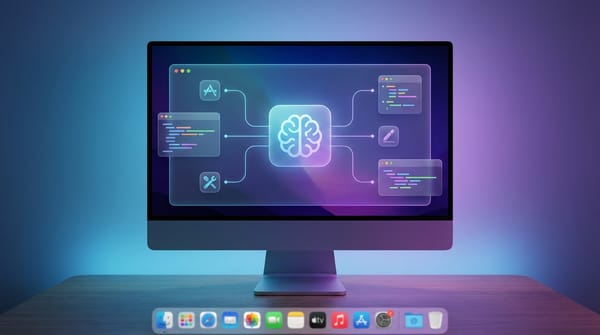
Traditional server architectures weren't designed for the unique demands of modern AI applications. They struggle with the dynamic resource allocation, distributed processing, and context management that contemporary AI systems require. Enter Model Context Protocol servers, a new infrastructure paradigm that's rapidly becoming the backbone of next-generation AI deployments.
MCP servers represent a fundamental rethinking of how AI applications interact with data and compute resources. Unlike conventional servers that treat each request independently, MCP infrastructure maintains persistent context across interactions, enabling AI systems to build on previous exchanges and maintain coherent understanding over extended sessions. This context-awareness isn't just a nice-to-have feature - it's essential for AI applications that need to understand complex, multi-step workflows.
The technical architecture behind MCP servers reflects this sophistication. Using a client-server model built on JSON-RPC 2.0, these systems enable asynchronous communication with robust error handling, allowing AI applications to interact with diverse data sources without the brittleness that plagued earlier implementations. The modular, flexible design means organizations can deploy MCP infrastructure across cloud, edge, and on-premises environments seamlessly, avoiding the vendor lock-in that has constrained so many technology investments.
Real-world applications demonstrate the practical value of this approach. Development teams are deploying Git bridges that allow AI systems to access entire codebases without retraining, dramatically improving efficiency in code refactoring and generation tasks. Financial institutions are using MCP infrastructure to enable real-time fraud detection that adapts to regulatory changes dynamically, while optimizing payment routing across decentralized environments. The technology is already powering production systems like DeepSpeed and ONNX Runtime, proving its readiness for enterprise-scale deployment.
Hardware Leaps: The Vera Rubin Era
Software infrastructure alone can't solve AI's scaling challenges. The computational demands of modern AI models require hardware specifically engineered for these workloads, and the latest generation of AI supercomputers represents a quantum leap in capability.
The Vera Rubin NVL72 AI supercomputer, unveiled at CES 2026, exemplifies this new generation of purpose-built AI hardware. This isn't an incremental improvement - it's a comprehensive reimagining of what AI compute infrastructure should look like. The system integrates six co-designed components: the Vera CPU, Rubin GPU, NVLink 6 switch, ConnectX-9 SuperNIC, BlueField-4 DPU, and Spectrum-6 Ethernet switch, all engineered to work together seamlessly.
The performance numbers are staggering. Each Rubin GPU delivers 50 PFLOPS for inference and 35 PFLOPS for training - up to 5x and 3.5x faster than the previous generation Blackwell GB200, respectively. With 288GB of HBM4 memory per package and NVLink 6 providing 3.6 TB/s per-GPU bandwidth that scales to 260 TB/s per rack, the system eliminates the memory and interconnect bottlenecks that have constrained AI workloads. The Vera CPU contributes its own impressive specs with 88 Olympus Arm cores and 1.5TB of SOCAMM memory.
Perhaps most importantly, this performance comes with dramatically improved economics. The platform promises to cut inference costs for mixture-of-experts models by 10x compared to previous architectures, with similar efficiency gains in training. For organizations running AI at scale, these cost reductions transform what's economically feasible, enabling applications that would have been prohibitively expensive just months ago.
A novel memory tier powered by BlueField-4 DPUs enhances inference throughput through shared context memory, while full-rack trusted execution addresses the security concerns that have slowed AI adoption in regulated industries. Production ramps in the second half of 2026, putting this capability in the hands of enterprises within months.
Government as Infrastructure Catalyst
The private sector isn't building this AI infrastructure alone. Government policy is playing an increasingly important role in accelerating deployment, particularly in addressing the thorniest challenges around energy, land use, and permitting.
A January 2025 executive order directed federal agencies to streamline permitting processes for large-scale AI infrastructure, including data centers and the clean energy facilities needed to power them. The Departments of Defense and Energy are selecting at least three sites each for private sector development, with requirements that developers bear all costs and use clean energy sources.
This government involvement addresses a critical bottleneck. Data center electricity consumption is projected to reach 12% of the national total by 2028, up from negligible levels just a few years ago. The exponential growth in AI compute demand is outpacing the grid's ability to deliver power, creating a constraint that no single company can solve alone. By facilitating grid connections, offering federal land, and expediting approvals, government agencies are removing obstacles that would otherwise slow AI infrastructure deployment by years.
The initiative reflects a recognition that AI infrastructure has become a matter of national security and economic competitiveness. Countries that can deploy AI at scale will have significant advantages in defense, scientific research, and economic productivity. The policy also attempts to balance rapid deployment with environmental protection and consumer affordability, though critics argue the environmental measures don't go far enough, particularly regarding water usage for cooling.
Enterprise Investment Patterns: Europe Doubles Down
While much attention focuses on American tech giants, European enterprises and governments are making massive AI infrastructure investments of their own. Tech spending in Europe is forecast to reach €1.5 trillion in 2026, with investment dominated by large enterprises and government entities.
Despite economic headwinds including U.S. tariffs, the EU economy shows resilience with stable GDP growth. Key sectors driving AI infrastructure investment include defense, financial services, healthcare, and retail. The United Kingdom is particularly notable for its transition from AI experimentation to implementation, especially in financial services.
The UK government has set ambitious targets, aiming for £22.6 billion in research and development spending by 2030 and doubling NHS technology funding to £10 billion by 2029. These aren't abstract commitments - they're translating into concrete infrastructure projects and procurement contracts that are reshaping the technology landscape.
European investment patterns differ somewhat from American approaches, with greater emphasis on regulatory compliance, data sovereignty, and environmental sustainability. The modular, distributed nature of MCP server architecture aligns well with these priorities, enabling organizations to keep sensitive data within jurisdictional boundaries while still leveraging AI capabilities. This regional variation in implementation approaches is actually healthy for the ecosystem, driving innovation in different directions and reducing the risk of technological monoculture.
Community-First Infrastructure Development
As AI infrastructure scales up, the social and environmental impacts of massive data centers are coming under scrutiny. Forward-thinking companies are responding with community-first approaches that aim to make AI infrastructure a net positive for the localities where it's deployed.
These initiatives go beyond token gestures. Commitments include ensuring data centers don't increase local electricity prices, minimizing water usage and replenishing more than is consumed, creating jobs for local residents, contributing meaningfully to the local tax base, and investing in AI training programs and local nonprofits. Major technology companies are partnering with communities in Texas, New Mexico, Wisconsin, and Michigan, creating thousands of jobs during both construction and operational phases.
The emphasis on local sourcing and hiring reflects a recognition that AI infrastructure projects can either be extractive - consuming local resources while providing minimal local benefit - or generative, creating lasting economic opportunities and skill development. Companies are providing technical skills training to ensure local residents can access the higher-wage jobs these facilities create, not just construction positions that disappear once buildings are complete.
Water usage deserves particular attention. AI data centers require enormous amounts of water for cooling, and in water-stressed regions, this can create genuine conflicts with agricultural and residential needs. Commitments to water replenishment - returning more water to local systems than facilities consume - represent a meaningful response to this challenge, though implementation details will determine whether these promises are kept.
The Economics of Practical AI
The infrastructure investments described above are only economically rational if AI delivers tangible business value. Fortunately, the evidence increasingly supports that case, particularly as AI moves from experimental projects to core operational systems.
Server spending is increasing by 36.9%, driven primarily by demand for AI-optimized hardware. Software spending is growing by 15.2%, reflecting the maturation of AI development platforms and tools. These aren't speculative investments - they're responses to demonstrated ROI in specific use cases.
Financial services are using AI infrastructure for dynamic fraud detection that adapts in real-time to emerging threats, dramatically reducing losses compared to rule-based systems. Healthcare organizations are accelerating drug discovery and optimizing treatment protocols. Retailers are using AI for demand forecasting and inventory optimization that reduces waste and improves margins. Manufacturing is deploying AI for predictive maintenance that prevents costly downtime.
The cost reductions from new hardware architectures are particularly significant. When inference costs drop by 10x, entire categories of AI applications that were economically marginal become clearly viable. This creates a positive feedback loop - better economics enable more deployment, which drives more infrastructure investment, which enables further cost reductions.
Device spending is showing more modest growth at 6.1%, constrained by higher memory prices and resulting market shortages. This imbalance - surging infrastructure spending but constrained endpoint spending - suggests AI applications will increasingly run in the cloud or at the edge rather than on end-user devices, at least in the near term.
From Experimentation to Implementation
The most fundamental shift in AI infrastructure isn't technological - it's organizational. Companies are moving AI from innovation labs and pilot projects into production systems that directly impact revenue and operations.
This transition requires different skills, processes, and mindsets than experimentation. Production AI systems need robust monitoring, clear escalation paths when things go wrong, integration with existing business processes, and governance frameworks that ensure responsible use. Infrastructure must support not just development and training, but deployment, monitoring, updating, and rollback.
The distributed, modular nature of modern AI infrastructure like MCP servers supports this operational maturity. By decoupling compute from central clouds, organizations reduce latency for time-sensitive applications while improving resilience - if one component fails, others continue operating. The ability to deploy across cloud, edge, and on-premises environments means organizations can optimize for their specific requirements rather than conforming to one-size-fits-all architectures.
Integration capabilities are particularly crucial. AI systems that exist in isolation deliver limited value. The real power comes when AI can access codebases, customer databases, transaction histories, and operational systems - understanding context and acting on comprehensive information. The Git bridge example mentioned earlier illustrates this: AI that can see and understand an entire codebase is exponentially more useful than AI working with isolated code snippets.
Security and compliance are no longer afterthoughts. Full-rack trusted execution, regulation-adaptive compliance systems, and robust audit trails are becoming standard features of AI infrastructure rather than expensive add-ons. This is essential for deployment in regulated industries like healthcare and finance, where the consequences of security breaches or compliance failures can be catastrophic.
Looking Ahead: Infrastructure as Competitive Advantage
The organizations winning with AI aren't necessarily those with the best algorithms or the most data scientists. They're the ones with superior infrastructure that enables rapid experimentation, efficient scaling, and reliable operation. AI infrastructure is becoming a competitive differentiator in its own right.
This has important implications for how companies should think about AI investment. The temptation is to focus on flashy applications - the chatbots, image generators, and other visible manifestations of AI capability. But sustainable competitive advantage comes from the less glamorous work of building robust infrastructure that can support a portfolio of AI applications over time.
The companies making massive infrastructure investments today - whether in MCP servers, next-generation hardware, or community partnerships that ensure reliable energy and social license to operate - are positioning themselves for long-term leadership. Those that treat AI as a series of one-off projects without investing in underlying infrastructure will find themselves perpetually behind, unable to scale successes or learn efficiently from failures.
The transition from hype to infrastructure is also democratizing AI capability. When running sophisticated AI models becomes 10x cheaper and infrastructure becomes more modular and accessible, smaller organizations can compete with tech giants. A startup with smart architecture choices can access capabilities that would have required massive capital investment just a few years ago.
The next phase of AI development won't be defined by breakthrough algorithms or novel architectures - those will continue to evolve incrementally. Instead, it will be defined by who can deploy AI most effectively at scale, integrating it seamlessly into business processes and delivering consistent value. That's an infrastructure challenge, and the foundations being laid in 2026 will determine who succeeds.
Conclusion: Building for the Long Term
The transformation of AI from experimental technology to essential infrastructure represents one of the most significant technology shifts in decades. The investments being made today - in novel server architectures, purpose-built hardware, government-facilitated energy and land access, and community partnerships - are creating the foundation for AI to become as ubiquitous and reliable as cloud computing or mobile connectivity.
What's particularly striking is how pragmatic this infrastructure buildout has become. The focus isn't on science fiction scenarios or artificial general intelligence. It's on solving concrete problems: reducing latency, improving cost-efficiency, ensuring regulatory compliance, managing energy consumption, and integrating with existing systems. This practical orientation is exactly what's needed to move AI from hype to reality.
The numbers tell the story. With global tech spending reaching $6.15 trillion, data center investments surging past $650 billion, and organizations across industries moving from experimentation to implementation, AI infrastructure is entering a period of sustained, substantial growth. The companies, governments, and communities that approach this buildout thoughtfully - balancing performance with sustainability, speed with responsibility, and innovation with integration - will be the ones that thrive in the AI-native economy taking shape around us.
Sources
- TechRadar - The Future of AI Applications: MCP Servers
- ITPro - Global Tech Spending is Skyrocketing
- Tom's Hardware - Nvidia Launches Vera Rubin NVL72 AI Supercomputer
- AP News - Biden Executive Order on AI Infrastructure
- Oracle - AI Infrastructure and Commitment to Local Communities
- Microsoft - Community-First AI Infrastructure Initiative