How AI Superfactories Are Rewriting the Rules of Global Compute
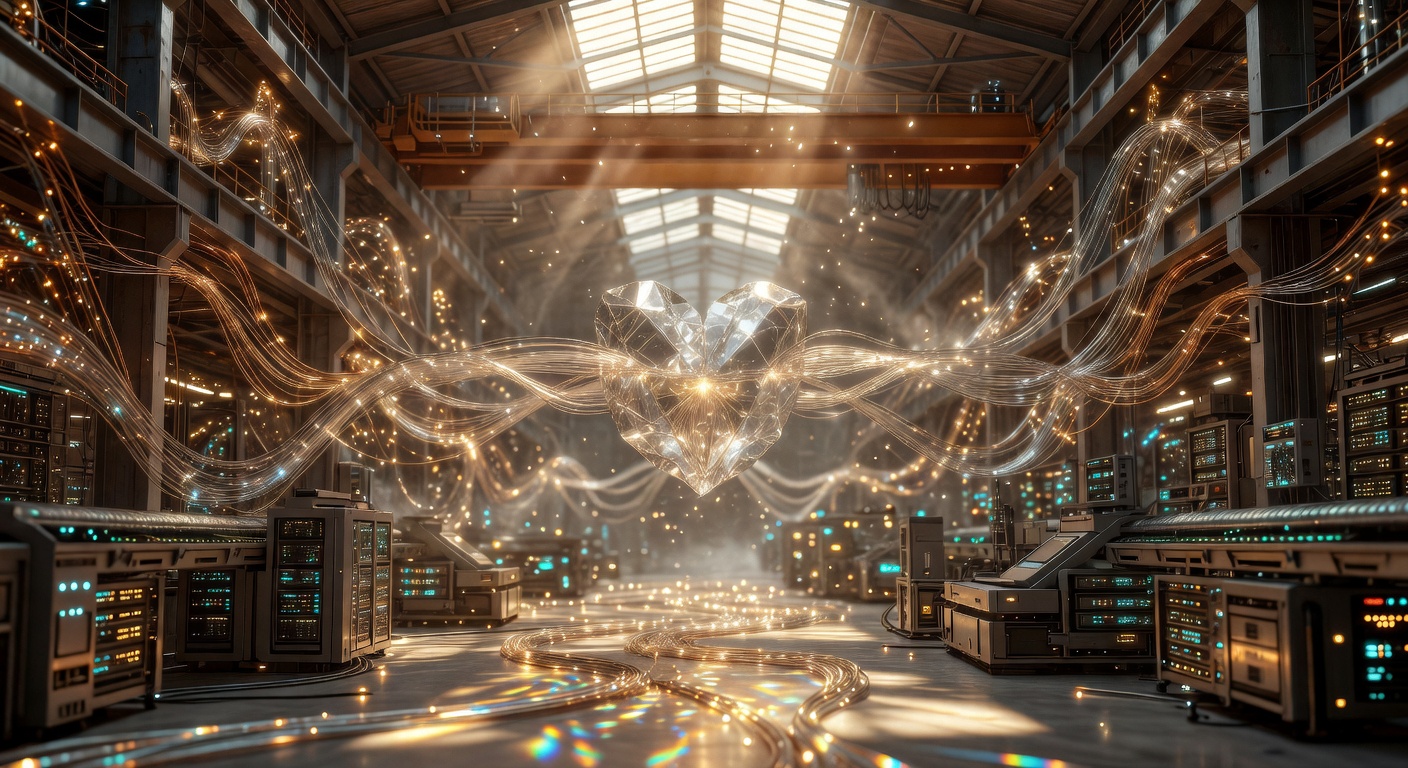
A quiet revolution is reshaping the backbone of artificial intelligence. The data centers that once stored files and served web pages are being replaced – or radically retrofitted – into something fundamentally different: AI superfactories. These purpose-built facilities don’t just process data. They manufacture intelligence at industrial scale, treating AI tokens the way an automotive plant treats finished vehicles – as measurable output optimized for throughput, cost, and energy per unit.
What makes this shift remarkable isn’t just the raw computing power involved. It’s the convergence of GPU-centric architecture, real-time grid coordination, liquid cooling at unprecedented density, and software orchestration that can flex an entire facility’s power draw in sub-second intervals. The result is a new class of infrastructure where a single day of downtime at a gigawatt-scale site can cost more than $100 million, and where the defining metric has moved from uptime alone to tokens per second per watt.
This article breaks down how these superfactories work, what makes them flexible, and why their relationship with the electrical grid may be the most consequential engineering challenge of the decade.
From Data Centers to Intelligence Manufacturers
Traditional data centers were built for general-purpose computing – handling diverse workloads across CPU-centric architectures. AI factories flip this model entirely. They are GPU-centric systems where RDMA and high-speed networking allow GPUs across machines to share memory, unlike commodity cloud environments. Every layer – from energy and chips to infrastructure, models, and applications – is unified into a system designed for training, fine-tuning, and high-volume inference.
The economic logic is stark. Over the past five years, pretraining scaling alone has increased compute requirements by 50 million times. Post-training scaling – fine-tuning models for real-world applications – demands roughly 30x more compute during inference than pretraining. And test-time scaling for agentic AI, where models explore multiple reasoning paths before selecting the best response, can consume up to 100x more compute than traditional inference. Traditional data centers simply weren’t designed for this.
NVIDIA’s internal deployment illustrates the payoff. By building a unified AI factory platform supporting hundreds of AI agents across enterprise workflows, the company compressed decades of engineering work into a single year and slashed supply chain planning times by over 95%.
The Power Problem – and Why It Became the Foundation
For decades, power and cooling were secondary concerns in data center design. Generative AI reversed that hierarchy. Power infrastructure is now the core driver for site selection, scale, and feasibility. Electric grids face gigawatt-scale buildouts to support AI alongside broader electrification, population growth, and industrial demand.
Modern AI racks push approximately 140 kW per rack and 1,360 kW per row – densities that would have been unthinkable five years ago. To handle this, a new power distribution paradigm is emerging: native 800 VDC delivery from facility-level generation direct to racks. By eliminating inefficient AC-to-DC conversions, this approach pushes end-to-end efficiency beyond 90%, compared to sub-90% in traditional systems. It also reduces failure points and supports future scalability beyond 1 MW per rack.
| Metric | Value | Context |
|---|---|---|
| Rack Power Density | ~140 kW | Microsoft Fairwater GPU-dense racks |
| Row Power Density | 1,360 kW | Facility-wide liquid cooling maximum |
| Downtime Cost (1 GW Site) | >$100M/day | Risk mitigation for gigawatt factories |
| 800 VDC Efficiency | >90% | Vs. <90% with traditional AC-DC chains |
| Cooling Water (Initial Fill) | ~20 homes/year | Closed-loop, 6+ year lifespan |
Cooling at Density: The Fairwater Approach
Packing GPUs this densely generates extraordinary heat. The Fairwater datacenter design addresses this with facility-wide closed-loop liquid cooling. The initial water fill is equivalent to what 20 homes consume annually, and the system is designed to last six or more years without evaporation or frequent replacement. Water chemistry is monitored, and replacement only occurs when indicated – not on a fixed schedule.
After cycling through cold plate paths across the GPU fleet, heat is dissipated by one of the largest chiller plants on the planet. This isn’t just about sustainability. Liquid-based cooling provides far higher heat transfer than air, which is what enables the 140 kW per rack density in the first place. It also allows large training jobs to run at high utilization in steady state – critical for frontier model development where even small efficiency losses compound across weeks of continuous operation.
Power-Flexible Factories: Grid Assets, Not Grid Burdens
Perhaps the most innovative development in AI infrastructure is the emergence of power-flexible factories – facilities that dynamically adjust their energy consumption in real time based on grid conditions. Rather than behaving as static, inflexible loads, these AI factories act as intelligent grid assets.
The concept was proven at the Aurora AI Factory in Manassas, Virginia – the world’s first facility certified to a new reference design for power-flexible AI infrastructure. Built on the NVIDIA Vera Rubin DSX AI Factory reference design and Emerald AI’s Conductor platform, Aurora integrates compute, power networking, and control into a single architecture. Emerald’s GridLink and Conductor work with NVIDIA’s AI Enterprise stack and Mission Control to coordinate workload scheduling and power management, enabling the facility to reduce demand when the grid needs relief while maintaining quality of service for high-priority workloads.
EPRI’s DCFlex Initiative validated the approach through demonstration testing, measuring precise, real-time responses to simulated grid-stress events like summer heatwaves and sudden drops in renewable generation. At a Nebius AI factory in London running 96 NVIDIA Blackwell Ultra GPUs on Quantum-X800 InfiniBand networking, the research team successfully reenacted the famous UEFA EURO 2020 “tea break” scenario – where millions of British viewers simultaneously switched on kettles, causing a roughly 1-gigawatt demand spike. The AI cluster ramped down power use to absorb the simulated surge without disrupting high-priority workloads. Emerald AI recorded 100% alignment with over 200 power targets during the experiment.
The Three Pillars of Grid Etiquette
- Energy storage systems: Fast, real-time compensation near racks catches sub-second spikes, while site-level batteries shape seconds-to-minutes ramps. Together they soften transients and prevent grid flicker.
- GPU performance tuning and workload pacing: Firmware and scheduler controls limit cycle-to-cycle ramp rates and suppress peak-power surges. This is precise, repeatable, and adaptable to new grid signals.
- Coordinated control strategies: Storage, compute, and power distribution move in sync – meeting ramp-rate limits, transient stability, harmonics and flicker standards, and voltage ride-through expectations.
The practical implication is significant: flexible AI factories can potentially interconnect with existing grids without waiting for years-long transmission upgrades, accelerating deployment while helping keep electricity rates affordable for everyday consumers.
Planet-Scale Architecture: Connecting Superfactories
No single facility – no matter how dense – can satisfy the compute demands of frontier model training, which now involves trillions of parameters. The solution is to link multiple superfactories into a planet-scale elastic system.
Microsoft’s approach connects its Fairwater sites in Wisconsin and Atlanta, along with prior-generation AI supercomputers and the broader Azure global footprint, via a dedicated AI WAN optical backbone. Over 120,000 new fiber miles were deployed across the U.S. in a single year to support this network. The result is a system where AI developers can segment traffic across scale-up networks within a site and scale-out networks across geographically diverse locations.
This design also embraces workload fungibility. Training has evolved from a single monolithic job into a range of workloads – pre-training, fine-tuning, reinforcement learning, synthetic data generation – each with different requirements. The AI WAN enables dynamic allocation across sites, maximizing GPU utilization of the combined system well above 90%.
The Atlanta Fairwater site achieves 4×9 availability (99.99%) at 3×9 cost (99.9%) by securing highly resilient utility power and forgoing traditional resiliency infrastructure like UPS systems, on-site generators, and dual-corded distribution. This drives meaningful cost savings and faster time-to-market.
The NVIDIA Rubin Platform and the Next Efficiency Leap
Hardware evolution continues to compress cost per token. The NVIDIA Rubin platform, unveiled at CES 2026, represents a shift from single-chip optimization to “extreme codesign” across six distinct chips – integrating the Vera CPU with the Rubin GPU via NVLink-C2C to eliminate traditional latency bottlenecks between processing units. The result is a 10x reduction in inference token cost compared to the Blackwell architecture, making agentic AI economically viable for mainstream enterprise adoption.
Enterprises can train trillion-parameter models with 4x fewer GPUs on this architecture. The BlueField-4 DPU introduces an Inference Context Memory Storage Platform that enables 5x higher tokens per second and reduces time-to-first-token – the critical metric for real-time applications. This suggests future AI factories will function as massive, interconnected memory pools rather than isolated compute nodes.
Avoiding Critical Deployment Mistakes
Building a power-flexible AI superfactory involves engineering tradeoffs that can be catastrophic if misjudged. Several common pitfalls have emerged from early deployments:
- Ignoring ramp-rate limits: Uncontrolled power fluctuations can cause grid flicker or localized blackouts. Enforce sub-5% second-by-second power changes via scheduler controls and validate with EPRI-style simulations before going live.
- Over-relying on static UPS: Traditional uninterruptible power supplies inflate costs without providing the flexibility that grid-integrated operations demand. For sites with resilient utility power, software-driven supplementary workloads and on-site storage are more effective.
- Poor telemetry integration: Delayed response to grid signals undermines the entire flexibility model. Standardize on seconds-level GPU power telemetry calibrated to sub-second accuracy.
- Monolithic workload scheduling: Running a single massive job with no flexibility margin blocks the facility from participating in demand response. Segment workloads into high-priority rigid tasks and flexible jobs that can be paused or throttled during grid stress events.
Digital twins built on NVIDIA Omniverse DSX Blueprints allow operators to simulate grid behavior, substations, and AI factory loads together before deployment – reducing risk and validating interconnection strategies before a single rack is powered on.
What Comes Next
The trajectory is clear. AI infrastructure is converging on a model where energy is the foundational design layer, power flexibility is a competitive advantage, and global networks of superfactories replace the single-site supercomputer paradigm. Partnerships between energy companies – AES, Constellation, Invenergy, NextEra Energy, Vistra, and others – and AI infrastructure providers are building the generation capacity needed for these facilities, including hybrid projects with co-located power.
Manufacturing and industrial sectors are following the same pattern. Factories deploying AI control centers with real-time optimization have reported process capability improvements of 108%, labor productivity gains of 30-40%, and defect reductions of up to 99% in lighthouse implementations. The AI factory model is not confined to training language models – it is becoming the operational backbone for physical-world intelligence.
For enterprises evaluating their next infrastructure investment, the message is straightforward: plan for rack-scale architecture, prioritize power as the primary design constraint, and treat grid flexibility not as a regulatory burden but as the fastest path to interconnection and deployment. The era of the AI superfactory has arrived, and it is reshaping not just computing – but the electrical grid, the energy economy, and the global competitive landscape alongside it.
Sources
- NVIDIA Blog: AI Factories Redefining Data Centers
- NVIDIA Blog: Energy-Efficient AI Factories and the Grid
- NVIDIA Blog: Power-Flexible AI Factories Stabilize the Grid
- NVIDIA: AI Factory Solutions Overview
- Latitude Media: First Flexible AI Factory and the Grid
- Microsoft Blog: Azure AI Superfactory Architecture
- Aragon Research: NVIDIA Rubin Reshapes the AI Factory
- NVIDIA Developer: 800 VDC Ecosystem for AI Factories