Huawei’s MWC 2026 Blitz: SuperPoD Clusters and AI-Native Networks
Huawei arrived at MWC Barcelona 2026 with arguably its most ambitious product lineup ever, debuting a full-stack AI computing platform, a reimagined network architecture infused with intelligence at every layer, and a comprehensive U6 GHz radio portfolio – all under the banner of “Advancing All Intelligence.” The company’s message was unmistakable: the era of agentic AI demands infrastructure that goes far beyond traditional connectivity, and Huawei intends to supply it from chip to cluster to network edge.
The headline hardware – the Atlas 950 and TaiShan 950 SuperPoDs – made their first appearance outside China, placing Huawei in direct competition with Nvidia’s DGX SuperPOD and AMD’s forthcoming Instinct-based MegaPod systems at the very top of the data center market. Meanwhile, the AI-Centric Network solutions signal a philosophical shift for carrier infrastructure, embedding machine reasoning into core network elements, service orchestration, and radio access rather than treating AI as a bolt-on analytics layer.
Together, these announcements paint a picture of a company that has navigated years of sanctions-driven chip constraints and emerged with an integrated, open-ecosystem alternative for global operators transitioning from 5G-Advanced toward 6G.
Atlas 950 SuperPoD: 8,192 NPUs as One Logical Computer
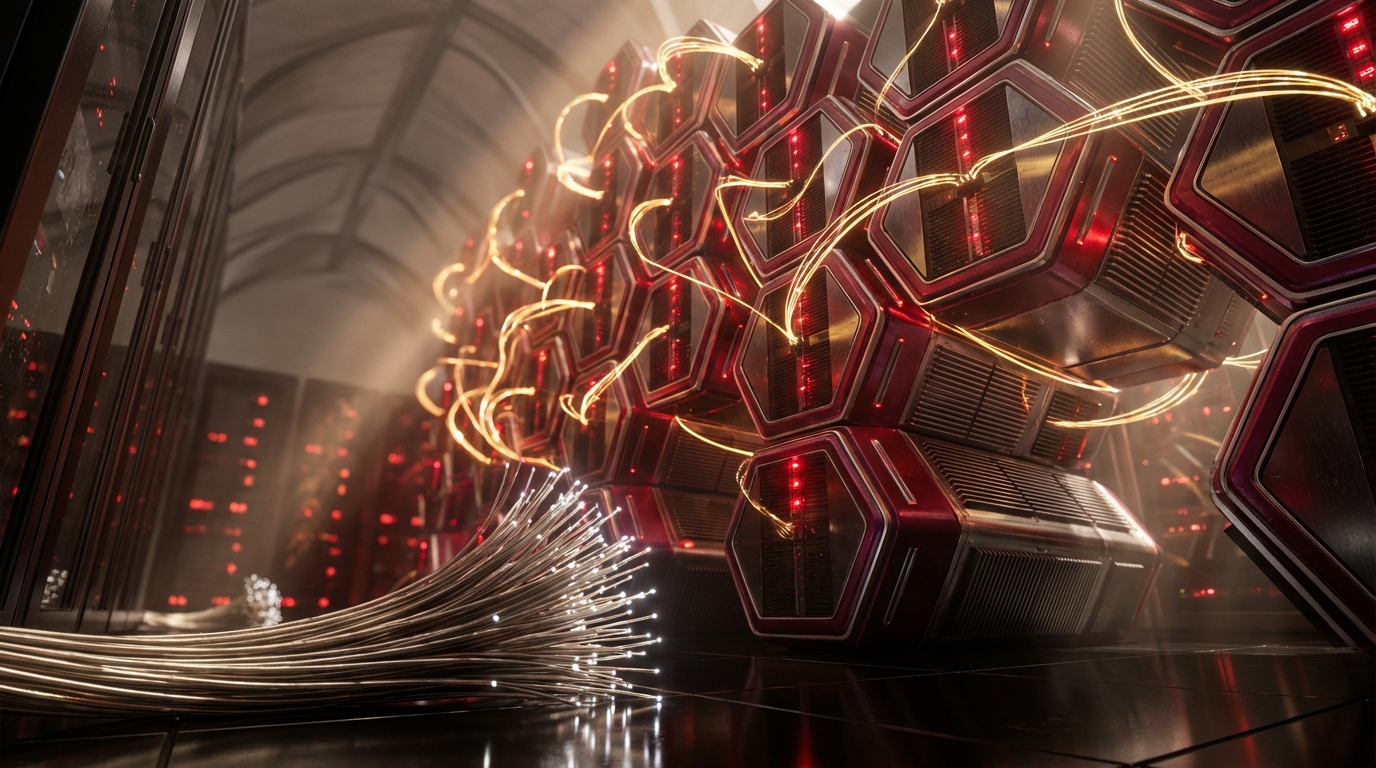
The Atlas 950 SuperPoD is built around Huawei’s Ascend neural processing units, connecting up to 8,192 NPUs through a proprietary interconnect called UnifiedBus. Rather than operating as thousands of loosely linked accelerators – where coordination overhead and latency degrade performance at scale – the system is engineered to behave as a single logical computer. This architectural choice targets the specific bottleneck that emerges when training trillion-parameter models or running million-token inference workloads across massive clusters.
At full configuration, the numbers are striking:
| Specification | Atlas 950 SuperPoD |
|---|---|
| NPU Count | Up to 8,192 Ascend NPUs |
| NPUs per Cabinet | 64 |
| Cabinet Count | 128-160 |
| Floor Space | ~1,000 m² |
| FP8 Performance | 8 exaFLOPS |
| FP4 Performance | 16 exaFLOPS |
| Memory | >1 petabyte |
| Interconnect Bandwidth | 16.3 PB/s |
| Interconnect Latency | Hundred-nanosecond level |
UnifiedBus enables unified memory addressing across all nodes using load/store semantics, which eliminates the costly data migration steps that plague conventional cluster architectures. Huawei’s Computing Product Line President, Seaway Zhang, emphasized that super nodes are essential for overcoming single-GPU limits when scaling to trillion-parameter models. Rotating Chairman Xu Zhijun framed the technology more bluntly: super nodes and clusters are critical to bypassing China’s chip technology limitations and sustaining AI computing supply.
The Atlas 950 runs on Huawei’s Ascend AI chips and integrates with CANN, the company’s open-sourced compute architecture supporting frameworks like PyTorch, vLLM, SGLang, Triton, and TileLang. This gives developers a path to build and deploy AI workloads without depending on Nvidia’s CUDA platform. Huawei has prior commercial experience here – hundreds of earlier Atlas 900 super nodes using Lingqu 1.0 interconnect technology are already deployed across China for large-scale AI training.
TaiShan 950 and the Broader Computing Portfolio
What makes Huawei’s MWC computing lineup distinctive is that it extends the SuperPoD architecture beyond dedicated AI training. The TaiShan 950 SuperPoD – described as the industry’s first general-purpose SuperPoD – matches the Atlas 950’s scale of up to 8,192 processing units, with TB-level bandwidth and memory pooling via the same load/store operations. It targets enterprise data center workloads that don’t fit neatly into the “AI training” bucket but still demand massive coordinated compute.
Rounding out the portfolio:
- Atlas 850E – Scales from 8 to 1,024 NPUs in standard air-cooled data centers, enabling carriers to start with small-scale inference and expand to cluster-level deployment without rearchitecting.
- TaiShan 500 series – Mid-tier general-purpose servers for moderate workloads.
- TaiShan 200 series – Entry-level servers integrated with openEuler OS and BoostKit software for lower-intensity requirements.
The chip roadmap calls for Ascend 950PR availability in Q1 2026 and 950DT in Q4 2026, with SuperPoD systems launching in China in Q4 2026. No international deployment dates have been confirmed yet, but the MWC debut clearly targets global carriers evaluating alternatives to Nvidia-dominated infrastructure.
AI-Centric Network Solutions: Intelligence at Every Layer
Huawei’s network announcements at MWC 2026 reflect a fundamental rethinking of where intelligence lives inside carrier infrastructure. The AI-Centric Network solutions embed AI across three distinct layers – network elements, the network itself, and services – preparing operators for what Huawei calls the “agentic era” with 7×24-hour inclusive intelligent connectivity.
The centerpiece is the Agentic Core, which leverages three engines:
- NE Intelligence – AI reasoning at the individual network element level
- Network Intelligence – Cross-network optimization and autonomous decision-making
- Service Intelligence – Monetization, differentiated service delivery, and intent-based orchestration
This isn’t AI as a monitoring dashboard. It’s AI making real-time operational decisions about traffic routing, service prioritization, and fault recovery. The new core network intelligence solution, for example, prioritizes faults by severity. Minor faults trigger automatic root cause analysis and recovery suggestions. Major service-impacting faults – which traditionally took around 90 minutes to resolve – now see the system intelligently reroute traffic to available paths, slashing average recovery time to just 15 minutes.
AI-Native Operations Framework
Huawei also introduced what it calls the industry’s first AI-Native framework for intelligent operations, built around three elements: Outcome Oriented design, DTN and Domain Model Driven architecture, and Agentic Operations. The framework uses digital twins and domain models specific to telecom, enabling what Huawei describes as efficient synergy between human experts and “digital employees.” Configuration commands are generated automatically by foundation models and validated in digital twin environments before deployment, compressing service rollouts from hours to minutes.
This builds on Huawei’s existing Autonomous Driving Network Level 4 (ADN L4) deployments. By the end of 2025, ADN L4 Phase 1 was commercially deployed on more than 130 telecom networks worldwide, focusing on single-scenario automation for operations and maintenance efficiency. The MWC 2026 announcements push toward full single-domain autonomy via AI agents and natural language intent interfaces.
U6 GHz Products and the 5G-A to 6G Bridge
Spectrum strategy was the third pillar of Huawei’s MWC presence. The company introduced a comprehensive U6 GHz product portfolio designed for high-capacity, low-latency network backbones that support the transition from 5G-Advanced to 6G. The U6 GHz band is under active allocation in China, the UAE, Brazil, and parts of Europe, making it a strategically important frequency range for operators planning long-term network evolution.
The products address a specific pain point: the explosive growth in uplink demand driven by AI applications, immersive services, and cloud-based collaboration. Huawei’s GigaUplink initiative targets large uplink capacity for mobile AI workloads, while GigaGreen focuses on energy-efficient, high-capacity performance. At the Mobile AI Summit held during MWC, operators shared their GigaUplink deployment progress for high-value applications, and Huawei jointly launched a “Build GigaUplink Network, Ignite Mobile AI Era” initiative with carrier partners.
The scale of 5G-A adoption provides context for these investments: globally, 70 million 5G-A users now exist, with Huawei enabling contiguous 5G-A coverage across 270 cities in China and monetized experience packages in more than 30 provinces.
Competitive Landscape: Huawei vs. Nvidia vs. AMD
The SuperPoD debut puts Huawei’s AI infrastructure ambitions in direct conversation with the established leaders. Here’s how the key platforms compare based on available specifications:
| Feature | Huawei Atlas/TaiShan 950 | Nvidia DGX SuperPOD/NVL | AMD Instinct MegaPod |
|---|---|---|---|
| Scale | 8,192 NPUs; 128-160 cabinets | Thousands of GPUs; established clusters | Forthcoming; Instinct-based |
| Performance | 8 EFLOPS FP8; 16 EFLOPS FP4 | High-precision GPU focus; widely deployed | Competitive accelerators planned |
| Interconnect | UnifiedBus (single logical system) | NVLink / CUDA ecosystem | AMD-specific scaling |
| Software Ecosystem | CANN / openEuler (open-source) | CUDA (mature, entrenched) | ROCm (growing) |
| Key Strength | Full-stack AI + general-purpose; China-deployed | Software maturity; global adoption | Cost/performance potential |
| Key Challenge | Sanctions; newer global ecosystem | High cost; supply constraints | Emerging vs. Nvidia lead |
Nvidia’s advantage remains its deeply entrenched CUDA software platform and GPU clusters already deployed across research labs and enterprise data centers worldwide. Huawei’s counter-argument centers on full-stack control – from Ascend chips and Kunpeng CPUs to Lingqu interconnect protocols and the openEuler operating system – plus the resilience argument for operators wary of single-vendor dependency.
Industrial Intelligence and Partner Ecosystem
Beyond carrier networks and AI compute, Huawei used MWC 2026 to showcase 115 industrial intelligence demonstrations spanning enterprise use cases, alongside 22 new industrial intelligence solutions developed with partners. The SHAPE 2.0 Partner Framework aims to accelerate intelligent transformation across sectors by giving ecosystem partners structured pathways for co-development and deployment.
The company also won GSMA Foundry Excellence Awards 2026 for its Mobile AI efforts alongside carrier partners, validating the joint work on 5G-A and AI convergence that has been underway across multiple markets.
Transport and Optical Network Modernization
Complementing the radio and compute announcements, Huawei unveiled next-generation mobile transport solutions designed for the expected surge in AI-driven data traffic. These upgrades introduce energy-efficient ultra-broadband capabilities, automated congestion detection, and enhanced network autonomy – practical necessities as networks evolve from 5G to 5G-A and eventually 6G. New optical network products were also launched for transport modernization, though detailed specifications were limited at the event.
What This Means for Carriers and the Road Ahead
Huawei’s MWC 2026 portfolio tells a coherent story: AI workloads are reshaping every layer of telecommunications infrastructure, from the radio edge to the data center core, and carriers need integrated solutions rather than piecemeal upgrades. The combination of SuperPoD compute clusters, AI-native network intelligence, and U6 GHz radio products represents Huawei’s bid to be the single-vendor option for operators navigating this transition.
For technical decision-makers, the practical takeaways are clear. Operators evaluating AI compute infrastructure now have a non-Nvidia option with demonstrated scale – 8,192 NPUs operating as a unified system – and an open-source software stack that avoids CUDA lock-in. Network teams can begin deploying ADN L4+ for single-domain autonomy, building on the more than 130 networks already running earlier versions, with a path toward natural language intent interfaces and minute-scale end-to-end automation. And spectrum planners should be tracking U6 GHz allocation timelines in their markets as a critical enabler for GigaUplink capacity.
The China launch of SuperPoD systems is targeted for Q4 2026, with global availability to follow. Whether Huawei can translate its domestic scale – 270 cities of contiguous 5G-A coverage, 70 million users, hundreds of Atlas 900 deployments – into international traction will depend on execution, ecosystem maturity, and the geopolitical landscape that continues to shape the global technology supply chain.
Sources
- Huawei Debuts Atlas 950 AI SuperPoD at MWC 2026 – TechRadar
- Huawei Pushes Networks Toward AI Intelligence – The Register
- Huawei Global Debut for AI Computing Clusters – SCMP
- Huawei SuperPoD AI Infrastructure Announcement
- Huawei Core Network Intelligence Solution Release
- Huawei Next-Gen Network Innovations – CXO Insight ME
- Huawei SuperPoD Portfolio at MWC 2026 – WebDisclosure
- Huawei Atlas and TaiShan 950 SuperPoDs – IndexBox
- Huawei Atlas 950 AI SuperPoD at MWC 2026 – Inkl